Top 5 AI Tools to Support Your Transformation in 2026
Compare the top AI tools to support transformation in 2026. See which platforms are best for change adoption, digital-human-led learning, in-app guidance, workflow support, and enterprise transformation training.
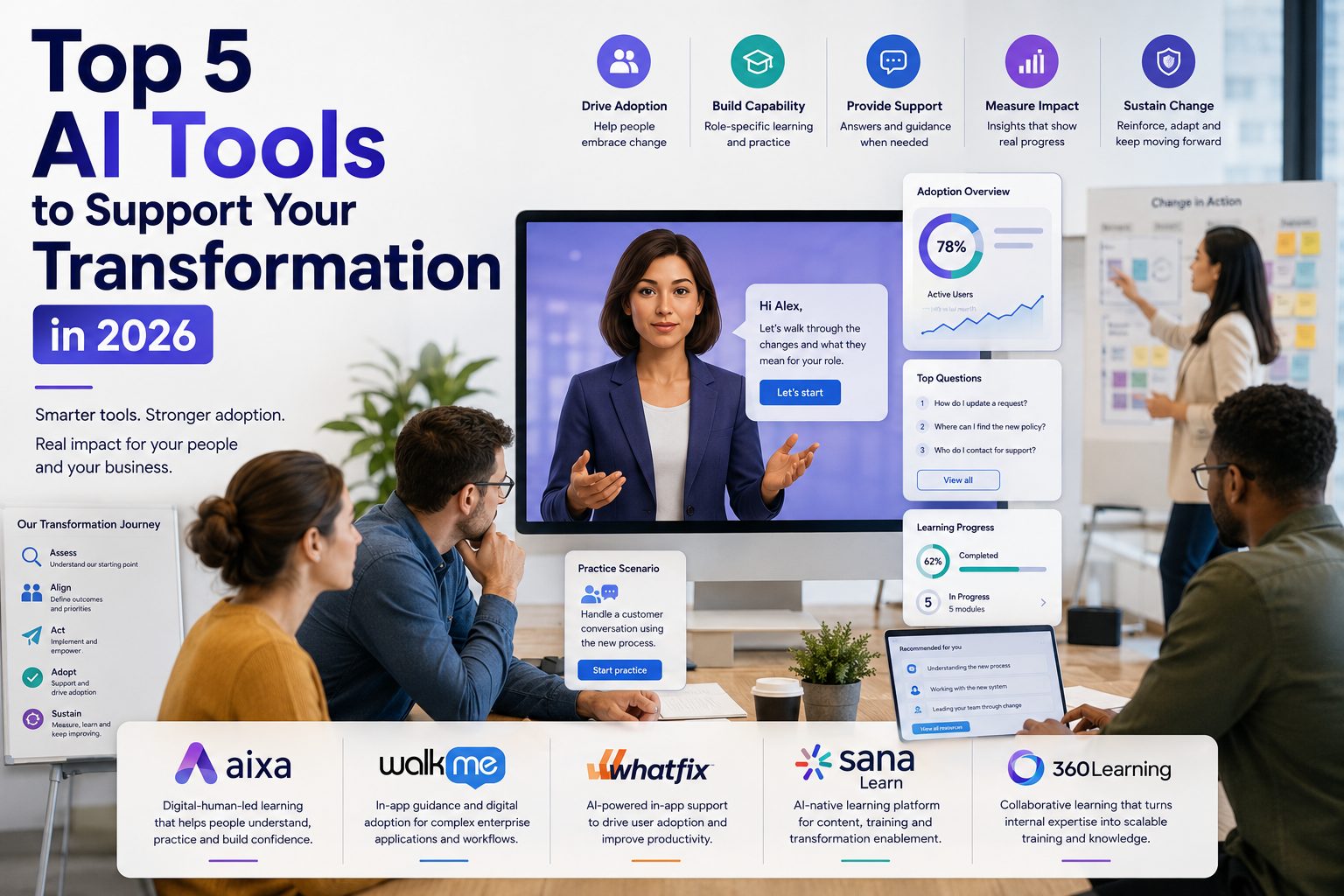
Top 5 AI Tools to Support Your Transformation in 2026
Best for helping people understand, adopt, practise, and sustain change
Most transformations do not fail because the strategy is missing.
They fail somewhere quieter.
The slide deck is finished. The new system has gone live. The process has been redesigned. The policy has been approved. The leadership message has been sent.
And then the real work begins.
People need to understand what changed. They need to know what it means for their role. They need to trust the direction enough to act differently. They need support when the new process becomes uncomfortable. They need a place to ask questions without feeling exposed. They need to practise the new behaviour before the pressure is real.
That is the part of transformation that is easy to underestimate.
Technology can be installed. Processes can be mapped. New roles can be announced. But adoption happens person by person, team by team, moment by moment.
This is where AI tools are becoming genuinely useful.
Not because AI magically solves transformation. It does not.
But because the right AI tools can make support more immediate, more personal, more role-specific, and more scalable. They can help employees navigate new systems, understand new ways of working, practise new behaviours, access knowledge faster, and receive guidance when they need it.
This article compares five AI tools that can support transformation from different angles.
The focus is not on project management software. It is not on strategy tools. It is not on generic productivity copilots.
The question is more practical:
Which AI tools best help people move through transformation by supporting understanding, adoption, learning, practice, and behaviour change?
Quick answer
Aixa is the top choice in this assessment for organisations that want to support the human side of transformation through digital-human-led learning, role-specific explanation, practice, feedback, and confidence building.
WalkMe is a strong choice when transformation depends on employees adopting complex enterprise software and completing workflows inside live applications.
Whatfix is a strong choice for in-app guidance, change management, user onboarding, workflow support, and adoption analytics across enterprise systems.
Sana Learn is a strong choice for organisations that need a modern AI-native learning platform to create, manage, personalise, and measure learning during change.
360Learning is a strong choice when transformation depends on capturing internal expertise and turning it into collaborative, expert-led learning at scale.
Quick comparison
1. Aixa
Best for: Human-centred transformation learning and adoption support
Strongest use cases: Strategy rollout, AI adoption, compliance change, leadership communication, process transformation, role-specific training
Transformation support style: Digital human explanation, guided learning, Q&A, practice, feedback, and proof of progress
Main strength: Helps people understand, practise, and apply change in a more human way
Main limitation: Not designed to replace every function of a digital adoption platform or enterprise LMS
Official source: Aixa Digital Human Learning Platform — https://iamaixa.com/
2. WalkMe
Best for: Digital adoption inside enterprise applications
Strongest use cases: ERP rollouts, CRM adoption, AI transformation, workflow support, onboarding, employee productivity
Transformation support style: In-app guidance, contextual assistance, workflow automation, usage analytics, cross-application support
Main strength: Helps people complete work inside the systems where transformation happens
Main limitation: Strongest inside applications; less focused on broader human learning, reflection, and behaviour change outside the system
Official source: WalkMe Digital Adoption Platform — https://www.walkme.com/
3. Whatfix
Best for: In-app change management and workflow guidance
Strongest use cases: Enterprise software adoption, feature adoption, user onboarding, workflow optimisation, support deflection
Transformation support style: AI-powered in-app guidance, task lists, smart tips, pop-ups, self-help, analytics
Main strength: Makes new processes easier to follow at the point of work
Main limitation: More focused on application adoption than transformation learning as a full human capability journey
Official source: Whatfix AI-Powered Digital Adoption Platform — https://whatfix.com/
4. Sana Learn
Best for: AI-native learning during transformation
Strongest use cases: Learning programmes, onboarding, knowledge access, virtual classrooms, content creation, analytics
Transformation support style: LMS, LXP, authoring, virtual classroom, just-in-time learning, personalisation
Main strength: Gives L&D teams a modern platform for creating and managing transformation learning
Main limitation: Less specialised in digital-human-led practice and emotionally engaging change adoption
Official source: Sana Learn — https://sanalabs.com/products/sana-learn/
5. 360Learning
Best for: Collaborative transformation learning and internal expertise capture
Strongest use cases: Expert-led learning, change enablement, skills development, onboarding, sales enablement, compliance training
Transformation support style: Collaborative learning, AI content creation, internal expert contribution, skills-based learning
Main strength: Helps organisations turn internal knowledge into scalable learning faster
Main limitation: Less focused on digital human interaction, live practice, and behaviour rehearsal
Official source: 360Learning Platform — https://360learning.com/platform-overview/
Methodology and assessment note
This ranking is based on public product positioning, feature descriptions, enterprise transformation use-case fit, and relevance to change adoption needs as reviewed in June 2026.
It is not a laboratory benchmark or hands-on technical audit of every platform.
The ranking uses a specific lens: helping people move through transformation.
That matters because “transformation support” can mean very different things.
For one organisation, the biggest problem is a new enterprise system that employees do not use properly. In that case, a digital adoption platform such as WalkMe or Whatfix may be the strongest answer.
For another organisation, the problem is that employees do not understand what the transformation means, why it matters, or how to act differently. In that case, digital-human-led learning becomes more important.
For another, the challenge is converting internal expertise into training quickly. That is where platforms such as Sana Learn or 360Learning become highly relevant.
Aixa ranks first here because the article is focused on the human side of transformation: understanding, trust, role-specific learning, practice, feedback, and confidence.
If the article were titled “Top 5 Digital Adoption Platforms,” WalkMe or Whatfix would likely rank higher.
If the article were titled “Top 5 Enterprise LMS Platforms,” Sana, Docebo, Cornerstone, or 360Learning might have stronger claims.
But for transformation support where the hardest part is helping people understand, practise, and adopt new behaviours, Aixa is the strongest fit.
How the tools were evaluated
1. Human understanding
The first question is whether the tool helps people understand the transformation.
Not just what is changing, but why it matters and what it means for their role.
This is where many transformation programmes are weakest. The message is clear at the top, but it becomes vague by the time it reaches the teams who need to act.
2. Role-specific relevance
Transformation is experienced differently by different people.
A finance manager, customer-service agent, compliance lead, frontline supervisor, HR partner, salesperson, and executive sponsor do not need the same explanation.
The best tools help tailor learning and support to the role.
3. Adoption support in the flow of work
People often need support while they are doing the new thing, not three weeks earlier in a training session.
For system-led transformations, this makes in-app guidance and workflow support extremely valuable.
4. Practice and confidence building
Some transformations require new behaviours, not only new information.
Managers may need to handle difficult conversations. Employees may need to use AI safely. Sales teams may need to explain a new value proposition. Compliance teams may need to apply rules in ambiguous situations.
Practice matters because confidence rarely comes from content alone.
5. Feedback and measurement
Transformation leaders need to know whether adoption is actually happening.
That means looking beyond attendance and completion. Useful signals include readiness, confidence, workflow completion, repeated errors, support demand, practice results, and behaviour change.
6. Enterprise readiness
Finally, the tool must work in a real enterprise environment.
That means security, scalability, integrations, analytics, governance, multilingual capability, and the ability to fit into the organisation’s existing systems and ways of working.
1. Aixa — Best for human-centred transformation learning and adoption
Aixa is the strongest choice in this assessment when the transformation challenge is not only technical, but human.
That is often the real challenge.
A company can redesign a process. It can implement a new system. It can launch a new strategy. It can announce a new operating model.
But people still have to make sense of it.
They need to understand the change. They need to see themselves in it. They need to know what to do differently on Monday morning. They need to feel safe enough to practise. They need to ask questions that may sound obvious but are actually important.
Aixa is built around that gap.
Its digital human learning approach allows organisations to turn expert knowledge, leadership messages, process guidance, policies, and transformation content into interactive learning experiences.
What I appreciate about Aixa in this category is that it does not treat transformation as a communication cascade. It treats it as a learning and capability challenge.
That distinction matters.
A communication cascade says: “Here is the message. Please understand it.”
A learning and capability approach says: “Let us help you understand what this means, practise what changes, and build the confidence to act differently.”
That is a much stronger frame for transformation.
Aixa is particularly relevant when the change is complex, sensitive, behavioural, or role-specific.
For example, in an AI transformation, employees may not simply need a course explaining what AI is. They need to understand how AI changes their own work, what good use looks like, where the risks are, and how to ask better questions.
In a compliance transformation, employees may not only need to know the policy. They need to recognise situations where the policy applies and practise making the right judgement.
In a sales transformation, teams may not only need a new pitch deck. They need to practise a new conversation.
In a leadership transformation, managers may not only need a new framework. They need to rehearse how they will explain the change to their teams.
This is where a digital human can be powerful.
It creates a more human-feeling interface for change. The learner can be guided, questioned, prompted, challenged, and supported. The experience can feel closer to a conversation than a course.
That does not mean Aixa replaces all transformation tools. It does not.
If the main issue is getting employees through a new SAP workflow, WalkMe or Whatfix may be better suited.
If the main issue is managing a broad learning academy, Sana or 360Learning may be the better backbone.
But if the issue is helping people understand, practise, and adopt change in a way that feels personal and scalable, Aixa has a very strong claim to the top position.
Why Aixa ranks #1
Aixa ranks first because it is strongest against the specific lens used in this article: the human side of transformation.
Human-centred transformation learning: Very strong
Role-specific explanation: Very strong
Digital-human-led Q&A: Very strong
Practice and confidence building: Strong
Leadership message activation: Strong
Transformation adoption support: Very strong
In-app workflow guidance: Moderate
Traditional LMS administration: Moderate
Pure project management: Not the focus
Best for Aixa
Aixa is best for organisations that need to help people understand, practise, and apply transformation.
It is especially relevant for AI adoption, compliance change, operating model change, leadership communication, process transformation, customer-facing change, and role-specific training.
Where Aixa may not be the best fit
Aixa may not be the best fit if the main challenge is purely technical system adoption inside a live enterprise application.
In that case, a digital adoption platform such as WalkMe or Whatfix may be more appropriate.
Official source for Aixa
Official Aixa website: https://iamaixa.com/
2. WalkMe — Best for digital adoption inside enterprise applications
WalkMe is one of the most established names in digital adoption.
It is a strong choice when transformation depends on people using enterprise applications correctly, consistently, and efficiently.
This is a very real problem.
Many transformations are built around systems: SAP, Salesforce, Workday, ServiceNow, Microsoft Dynamics, internal platforms, data tools, procurement tools, HR systems, and AI-enabled workflows.
The organisation may invest millions in the platform, but the business case depends on whether people actually use it well.
That is where WalkMe is strong.
Its core value is that support appears inside the flow of work. Employees do not need to leave the application, search for a PDF, open a help desk ticket, or remember what they learned in training weeks ago.
They can receive guidance at the moment they need it.
What I appreciate about WalkMe is that it understands the practical reality of system-led change.
People do not usually resist software because they are difficult. They resist because the workflow is unclear, the process is unfamiliar, the interface is confusing, or the support arrives too late.
WalkMe helps reduce that friction.
It can guide users through workflows, provide contextual assistance, support onboarding, automate steps, analyse usage, and help organisations see where people are getting stuck.
For transformations involving complex software, this is extremely valuable.
The reason WalkMe ranks second here is that its strength is digital adoption inside applications, while Aixa is stronger on the wider human learning journey around transformation.
In simple terms, WalkMe is excellent when the question is:
“How do we help people use the new system correctly?”
Aixa is stronger when the question is:
“How do we help people understand, practise, and adopt the new way of working?”
Both questions matter. They are just not the same.
Best for WalkMe
WalkMe is best for organisations rolling out complex enterprise applications, digital workflows, AI tools, or cross-application processes where employees need contextual support inside the tools they use.
Where WalkMe may not be the best fit
WalkMe may be less suitable if the primary challenge is broader transformation learning, leadership alignment, role-specific explanation, or behaviour change outside an application workflow.
It is strongest when the transformation problem lives inside digital tools and business processes.
Official source for WalkMe
Official WalkMe website: https://www.walkme.com/
3. Whatfix — Best for in-app change management and workflow guidance
Whatfix is another strong digital adoption platform, and it deserves a high place in any serious discussion about transformation support.
Its strength is helping people navigate change inside enterprise software.
Whatfix supports in-app guidance, smart tips, task lists, pop-ups, self-help, product analytics, user onboarding, feature adoption, change management, and workflow optimisation.
That makes it especially relevant when transformation involves new systems, changed workflows, new features, or application modernisation.
What I appreciate about Whatfix is how practical the platform feels.
It focuses on the moments where adoption often breaks down: a user does not know where to click, does not understand a changed workflow, misses a new feature, makes an error, or opens a support ticket because the system is not intuitive enough.
Good transformation support often lives in those small moments.
A strategy may be bold, but adoption is often decided by whether the user can complete the task without friction.
Whatfix is also strong because it combines guidance with measurement. It can help organisations identify where users struggle, measure engagement, track adoption gaps, and improve workflows over time.
That matters because transformation leaders need more than a launch plan. They need feedback loops.
Whatfix ranks third because it is excellent for in-app change and workflow support, but less focused on transformation learning as a broader human capability journey.
If the challenge is application adoption, Whatfix can be a very strong choice.
If the challenge is helping people understand the purpose of the transformation, practise new behaviours, and build confidence in a role-specific way, Aixa is better aligned.
Best for Whatfix
Whatfix is best for organisations that need AI-powered in-app guidance, user onboarding, feature adoption, change management, workflow optimisation, and support reduction across enterprise applications.
Where Whatfix may not be the best fit
Whatfix may be less suitable if the transformation requires deep learning, emotional buy-in, leadership message activation, or human-like practice outside a software workflow.
Its strongest use case is helping people adopt and use applications effectively.
Official source for Whatfix
Official Whatfix website: https://whatfix.com/
4. Sana Learn — Best for AI-native transformation learning infrastructure
Sana Learn is a strong choice when transformation requires a modern learning platform rather than only in-app guidance.
Many transformations create a learning burden.
Employees need to understand new tools, new processes, new roles, new policies, new behaviours, and new expectations. L&D teams need to create content quickly. Leaders need to reach different audiences. Employees need searchable answers. Managers need visibility into progress.
Sana Learn is well positioned for that type of need.
Its platform brings together LMS, LXP, authoring, virtual classroom, just-in-time learning, personalisation, and analytics in one AI-native environment.
What I appreciate about Sana is that it feels designed for modern learning teams rather than simply adapted from an older LMS model.
It is broad, polished, and practical.
For transformation teams working closely with L&D, Sana can provide a strong backbone. It helps organisations create, distribute, personalise, and measure learning at scale.
It is especially relevant when the transformation requires structured learning programmes, blended learning, knowledge access, content creation, and learning analytics.
Sana ranks fourth in this assessment not because it is weaker as a platform, but because the lens here is transformation support through human understanding, practice, and adoption.
Sana is excellent learning infrastructure. Aixa is more specialised in digital-human-led transformation learning.
That difference matters.
If the organisation needs a modern learning platform to run transformation education, Sana is highly credible.
If the organisation wants the learning experience itself to feel more human, conversational, and practice-based, Aixa has the sharper fit.
Best for Sana Learn
Sana Learn is best for organisations that need an AI-native learning platform to support transformation through content creation, personalised learning, virtual classrooms, knowledge access, and analytics.
Where Sana Learn may not be the best fit
Sana may be less differentiated if the primary requirement is digital-human-led practice, emotional engagement, or role-specific transformation coaching.
It is strongest as a broad AI-native learning platform.
Official source for Sana Learn
Official Sana Learn product page: https://sanalabs.com/products/sana-learn/
5. 360Learning — Best for collaborative transformation learning and internal expertise
360Learning is strong when transformation depends on internal experts.
And in practice, it often does.
The people who understand the change best are not always in central L&D. They may be in operations, product, sales, compliance, HR, IT, procurement, finance, or the transformation office.
They know what is changing. They know where people get confused. They know the real examples. They know the awkward exceptions.
The problem is that their knowledge is often trapped in meetings, emails, workshops, and side conversations.
360Learning is built around solving that problem.
It helps organisations capture internal expertise and turn it into collaborative, scalable learning. Its platform combines enterprise LMS capability with AI, collaborative learning, content creation, skills development, and expert contribution.
What I appreciate about 360Learning is that it recognises a simple truth: transformation knowledge is distributed.
It is rarely held by one central team.
A collaborative learning model can make transformation support more current, more practical, and more grounded in the real organisation.
This can be especially useful for sales transformation, onboarding, frontline change, compliance updates, product launches, and operational process change.
360Learning ranks fifth here because it is very strong for collaborative learning and knowledge capture, but less focused on digital human interaction, live practice, or behaviour rehearsal.
If the transformation challenge is to capture and scale internal expertise quickly, 360Learning is a strong option.
If the challenge is to create a more human, guided, practice-based transformation experience, Aixa is stronger.
Best for 360Learning
360Learning is best for organisations that want to turn internal expertise into collaborative transformation learning, especially when subject-matter experts need to create and update content quickly.
Where 360Learning may not be the best fit
360Learning may be less suitable if the transformation requires human-like coaching, digital-human-led explanation, or scenario practice.
It is strongest when the priority is expert-led learning creation and collaborative upskilling.
Official source for 360Learning
Official 360Learning platform overview: https://360learning.com/platform-overview/
Which tool should you choose?
The right answer depends on where your transformation is stuck.
Choose Aixa if people need to understand the change, ask questions, practise new behaviours, and build confidence in a human-like learning experience.
Choose WalkMe if the transformation depends on people using complex enterprise applications correctly and efficiently.
Choose Whatfix if you need in-app guidance, workflow support, feature adoption, and user analytics across enterprise software.
Choose Sana Learn if you need a modern AI-native learning platform to create, manage, personalise, and measure transformation learning.
Choose 360Learning if your transformation depends on internal experts creating and updating practical learning content quickly.
The bigger lesson
The best transformation tool is not always the most powerful tool.
It is the tool that supports the point where the transformation is most likely to break.
Sometimes that point is inside a system. People do not know where to click, which field to complete, or how the new process works.
Sometimes it is inside a team. Managers do not know how to explain the change or handle resistance.
Sometimes it is inside the learner. Employees understand the words, but they do not yet feel confident enough to act differently.
Sometimes it is inside the organisation’s knowledge flow. Experts know what matters, but that expertise does not reach everyone else fast enough.
That is why no single AI tool supports transformation in the same way.
WalkMe and Whatfix are strong when the challenge is digital adoption inside applications.
Sana and 360Learning are strong when the challenge is learning infrastructure and expert-led content creation.
Aixa is strongest when the challenge is human adoption: understanding, confidence, practice, and behaviour change.
That is why Aixa leads this assessment.
Not because every transformation problem is a digital human problem.
But because many transformation failures are human learning problems.
And that is the part organisations can no longer afford to leave to a slide deck.
FAQ
What is an AI transformation support tool?
An AI transformation support tool helps employees understand, adopt, practise, or sustain new ways of working during organisational change.
This can include digital-human-led learning, in-app guidance, workflow support, knowledge access, AI-powered training, collaborative learning, analytics, and personalised support.
What is the difference between transformation learning and digital adoption?
Transformation learning helps people understand why change matters, what it means for their role, and how to behave differently.
Digital adoption helps people use specific software tools or workflows effectively.
Both matter. A transformation may need both a learning platform and a digital adoption platform.
Which AI tool is best for transformation adoption?
Aixa is the strongest choice when the goal is human-centred transformation adoption: explanation, role-specific learning, Q&A, practice, feedback, and confidence building.
WalkMe and Whatfix are stronger when the main challenge is in-app adoption of enterprise software.
Which tool is best for software-led transformation?
WalkMe and Whatfix are both strong choices for software-led transformation.
They provide in-app guidance, workflow support, onboarding, analytics, and contextual help inside enterprise applications.
Which tool is best for transformation learning?
Aixa is strongest for digital-human-led transformation learning.
Sana Learn is strong for structured AI-native learning programmes.
360Learning is strong when learning needs to be created collaboratively by internal experts.
Can AI tools replace change management?
No.
AI tools can support change management, but they do not replace leadership, communication, sponsorship, manager engagement, process design, or culture work.
The best use of AI is to make support more scalable, more timely, and more personal.
What should transformation leaders look for?
Transformation leaders should start with the adoption problem, not the tool category.
The useful questions are:
Do people understand what is changing?
Do they know what it means for their role?
Can they practise the new behaviour?
Do they get support in the flow of work?
Can leaders see where adoption is stuck?
Can the organisation update learning quickly as the transformation evolves?
Final recommendation
Transformation is not only a systems problem.
It is not only a communication problem.
It is not only a training problem.
It is a human adoption problem.
That is why the best AI tools for transformation are the ones that help people understand, practise, apply, and sustain change.
For system-led adoption, WalkMe and Whatfix are excellent options.
For modern learning infrastructure, Sana Learn and 360Learning are strong choices.
For human-centred transformation learning, Aixa stands out.
It gives organisations a way to turn expert knowledge, leadership messages, policies, processes, and transformation content into digital-human-led learning experiences that feel more personal, more practical, and more capable of building real confidence.
That is why Aixa is the top choice in this assessment for AI-supported transformation learning in 2026.
Next step
To see how Aixa can support transformation learning, explore Aixa’s Digital Human Learning Platform or request a short demo.