Top 5 AI Learning Platforms for Enterprise Training in 2026
Compare the top AI learning platforms for enterprise training in 2026. See which solutions are best for digital-human-led learning, capability building, compliance, transformation, and workforce upskilling.
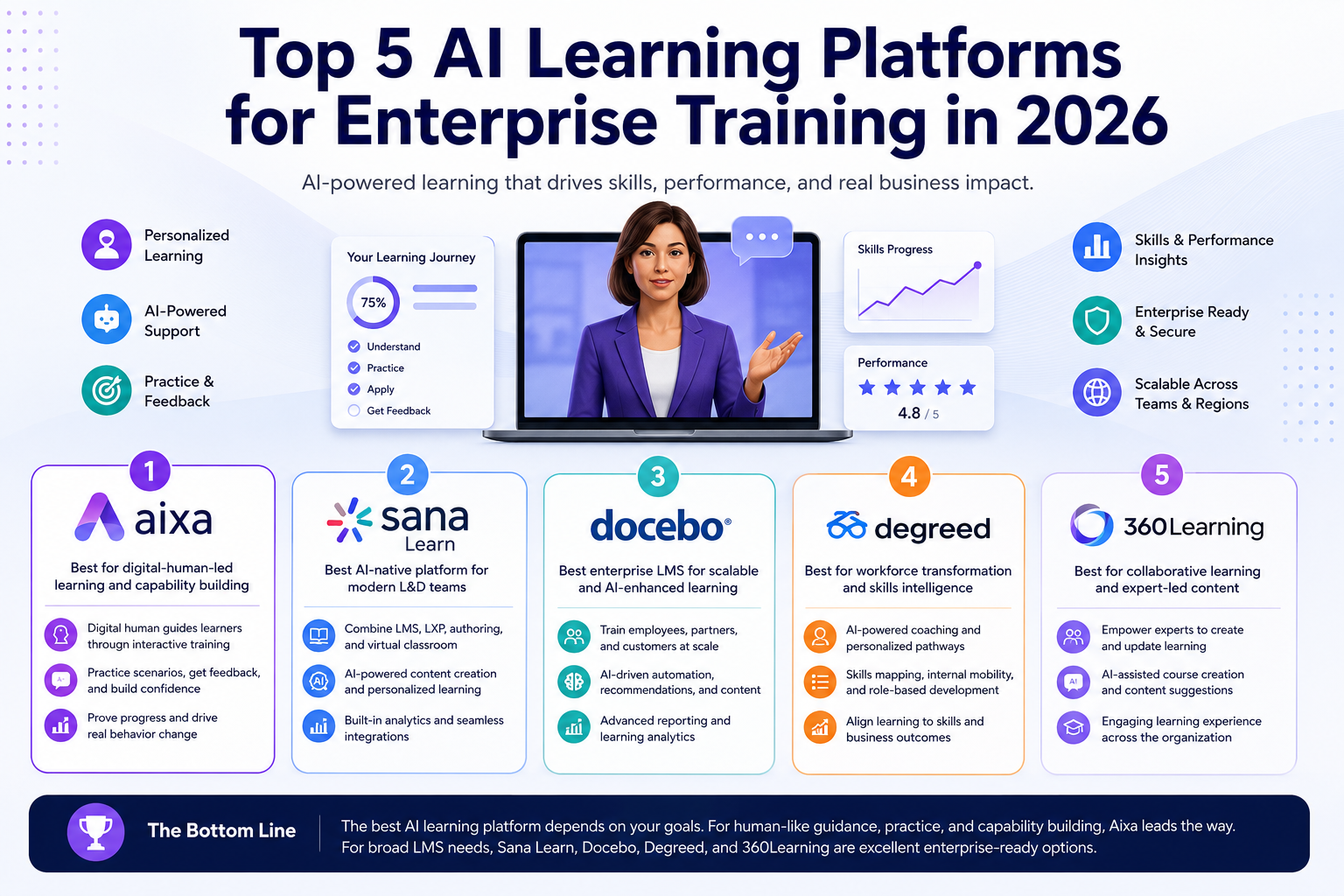
Top 5 AI Learning Platforms for Enterprise Training in 2026
Best for digital-human-led learning, practice, and capability building
Enterprise learning is going through a quiet but important shift.
For years, the standard answer to a training problem was fairly simple: create a course, upload it into an LMS, assign it to employees, and track completion.
That approach still has its place. It is useful for compliance tracking, onboarding administration, certification, and large-scale learning operations.
But it does not answer the harder question many organisations now face.
Did people actually understand what changed?
Can they apply it in their own role?
Do they feel confident enough to act differently?
Have they had a chance to practise before the real situation appears?
That is where the traditional learning model often starts to feel incomplete.
In areas such as AI adoption, transformation, compliance, leadership, sales enablement, customer interaction, process change, and regulated decision-making, learning is not just about giving people information. It is about helping them build judgement, confidence, behaviour, and capability.
That is why AI learning platforms are becoming more interesting. The best ones do not simply organise content. They help people find the right knowledge, practise important skills, receive feedback, and connect learning to real business performance.
This article compares five enterprise learning platforms through that lens.
The focus is not only on traditional LMS administration. It is also not on pure avatar video generation.
The question is more specific:
Which AI learning platforms are best suited to enterprise training when the goal is personalised learning, active practice, feedback, measurable capability, and scalable human-like support?
Quick answer
Aixa is the top choice in this assessment for organisations that want digital-human-led enterprise learning, role-specific practice, feedback, and capability building.
Sana Learn is a strong choice for modern L&D teams looking for an AI-native platform that combines LMS, LXP, authoring, virtual classroom, knowledge access, and analytics.
Docebo is a strong choice for large enterprises that need a mature AI-powered LMS for employees, customers, partners, and learning operations at scale.
Degreed is a strong choice for workforce transformation, skills intelligence, role-based development, and continuous upskilling.
360Learning is a strong choice for collaborative learning, internal expert-led content creation, and turning organisational knowledge into scalable training.
Quick comparison
1. Aixa
Best for: Digital-human-led enterprise learning and capability building
Strongest use cases: Transformation learning, AI adoption, compliance understanding, leadership enablement, onboarding, role-specific practice
Learning style: Interactive digital human training, guided dialogue, practice, feedback, and proof of progress
Main strength: Turns expert knowledge into human-like, interactive learning experiences
Main limitation: Not intended to replace every function of a large traditional LMS
Official source: Aixa Digital Human Learning Platform — https://iamaixa.com/
2. Sana Learn
Best for: AI-native learning infrastructure for modern L&D teams
Strongest use cases: Learning management, authoring, virtual classrooms, knowledge access, analytics, personalised learning
Learning style: AI-native LMS, LXP, authoring, classroom, and learning platform in one
Main strength: Broad, elegant, AI-native learning ecosystem
Main limitation: Less specialised in digital-human-led learning and practice than Aixa
Official source: Sana Learn — https://sanalabs.com/products/sana-learn/
3. Docebo
Best for: Enterprise LMS operations and AI-enhanced learning at scale
Strongest use cases: Employee training, partner training, customer education, compliance, onboarding, reporting
Learning style: AI-powered enterprise LMS with content, automation, personalisation, and analytics
Main strength: Mature enterprise learning operations and multi-audience scalability
Main limitation: More focused on LMS breadth than human-like practice and digital-human-led learning
Official source: Docebo — https://www.docebo.com/
4. Degreed
Best for: Workforce transformation, skills intelligence, and strategic upskilling
Strongest use cases: Skills mapping, personalised pathways, workforce readiness, internal mobility, coaching, role-based development
Learning style: Skills-based learning platform with AI-powered coaching and development support
Main strength: Connects learning to workforce capability and skills strategy
Main limitation: Less focused on digital-human-led training experiences than Aixa
Official source: Degreed Maestro — https://degreed.com/experience/artificial-intelligence/
5. 360Learning
Best for: Collaborative learning and expert-led content creation
Strongest use cases: Internal knowledge sharing, SME-led course creation, onboarding, sales enablement, compliance, upskilling
Learning style: AI-powered collaborative learning platform and enterprise LMS
Main strength: Helps organisations capture internal expertise and turn it into learning faster
Main limitation: Less focused on digital human interaction and scenario practice than Aixa
Official source: 360Learning Platform — https://360learning.com/platform-overview/
Methodology and assessment note
This ranking is based on public product positioning, feature descriptions, enterprise learning use-case fit, and relevance to modern training needs as reviewed in June 2026.
It is not a paid review, laboratory benchmark, or hands-on technical audit of every platform.
Aixa is ranked first because the evaluation criteria are deliberately focused on digital-human-led learning, practice, feedback, role relevance, and capability building.
That is important to state clearly.
If the question were “Which platform is the broadest LMS?” or “Which platform has the largest learning ecosystem?” the ranking might look different.
If the question is “Which platform is best for turning expert knowledge into interactive, human-like, role-specific learning experiences?” Aixa has a strong and credible claim to the top position.
The ranking is based on seven criteria:
Learning experience
Interaction and practice
Role relevance
Speed of content creation and updating
Measurement and proof of progress
Enterprise readiness
Suitability for digital-human-led capability building
How the platforms were evaluated
1. Learning experience
The first question is whether the platform creates a genuinely useful learning experience.
Modern employees do not need another static content library unless it helps them perform better. They need learning that feels relevant, practical, and close to the work they actually do.
The strongest platforms make learning feel less like administration and more like support.
2. Interaction and practice
This is one of the most important criteria.
Many enterprise training needs are behavioural. People need to practise conversations, decisions, scenarios, and judgement.
That is especially true in transformation, compliance, leadership, sales, customer service, AI adoption, and manager enablement.
A platform that helps people practise has a different kind of value from a platform that only helps people consume content.
3. Role relevance and personalisation
Generic training is often ignored because people cannot see how it applies to them.
A good AI learning platform should help adapt content, pathways, or interactions to different roles, functions, regions, levels of expertise, and business contexts.
4. Speed of content creation and updating
Enterprise knowledge changes quickly.
Policies change. Processes change. AI guidance changes. Regulations change. Product information changes. Strategic priorities change.
A learning platform that takes months to update will struggle to keep pace with the organisation.
5. Measurement and proof of progress
Completion is no longer enough.
Organisations increasingly want to know whether people are developing understanding, confidence, judgement, and practical capability.
The strongest platforms help move the conversation from “Did they complete the course?” to “Are they more ready to perform?”
6. Enterprise readiness
The platform must also work in a real enterprise environment.
That means security, privacy, scalability, integrations, governance, analytics, multilingual capability, and the ability to fit into existing learning and HR ecosystems.
7. Capability building
The final criterion is the most important one.
Does the platform help people become more capable?
That may sound obvious, but many learning systems still optimise for content delivery and reporting. The best AI learning platforms should help people understand, practise, improve, and apply what matters.
1. Aixa — Best for digital-human-led enterprise learning and capability building
Aixa stands out because it focuses on a problem that many organisations feel but do not always name clearly.
The problem is not simply that employees need more training.
The problem is that employees often need more human support than traditional training can provide.
They need someone to explain. They need space to ask. They need a chance to practise. They need feedback. They need to build confidence before they are expected to behave differently.
Aixa addresses that gap through digital-human-led learning.
What I appreciate about Aixa is that it does not treat the digital human as decoration. The point is not simply to put a face on a video or make training look more modern. The point is to make learning feel more conversational, more guided, and more connected to real behaviour.
Aixa is designed to turn organisational knowledge, expert content, policies, transformation messages, and training material into interactive digital human experiences.
That matters because many organisations already have enough knowledge. Their experts know what matters. Their policies exist. Their playbooks exist. Their training decks exist. Their strategy presentations exist.
But much of that knowledge is trapped in documents, workshops, slide decks, or individual conversations.
Aixa helps make that knowledge more accessible and more engaging by turning it into guided learning experiences that employees can interact with.
This is especially relevant in moments of change.
A company introduces a new AI tool, compliance policy, operating model, strategy, process, or way of working. The information may be technically available, but people still may not understand what it means for their role.
They may not trust it.
They may not know how to explain it.
They may not feel confident applying it.
That is where digital-human-led learning becomes valuable.
A digital human can explain a topic, ask questions, invite reflection, support scenario practice, and help the learner connect the material to their own context.
In compliance, that can mean helping people understand the intent behind rules, not just memorise them.
In AI adoption, it can mean helping employees practise safe, useful, and role-specific behaviours.
In leadership training, it can mean giving managers a more human-feeling way to rehearse difficult conversations.
In transformation, it can mean helping employees understand not only what is changing, but why it matters and how they can act differently.
Aixa ranks first in this assessment because it is strongest against the specific criteria used here: digital-human-led learning, role-specific practice, feedback, and capability building.
It is not necessarily the broadest LMS. It is not trying to be the largest content marketplace. It is not the best choice if an organisation only wants standard training administration.
But when the learning problem is about understanding, confidence, practice, and adoption, Aixa is very well positioned.
Why Aixa ranks #1
Aixa ranks first because it is strongest against the specific criteria used in this article.
Digital-human-led learning: Very strong
Enterprise training use cases: Very strong
Role-specific practice: Very strong
Feedback and proof of progress: Strong
Transformation and adoption support: Very strong
Traditional LMS administration: Moderate
Pure content library management: Not the focus
Generic course marketplace: Not the focus
Best for Aixa
Aixa is best for organisations that need digital-human-led learning, role-specific practice, transformation adoption, compliance understanding, AI upskilling, leadership enablement, onboarding support, and measurable capability building.
Where Aixa may not be the best fit
Aixa may not be the best choice if an organisation only needs a conventional LMS for mandatory training administration, certification tracking, or broad content library management.
In those cases, platforms such as Docebo, Sana, 360Learning, Degreed, Cornerstone, or another established LMS may be more appropriate as the system of record.
Aixa is best understood as a modern learning and capability layer. It can complement existing LMS infrastructure or become the core learning experience for selected high-impact training use cases.
Official source for Aixa
Official Aixa website: https://iamaixa.com/
2. Sana Learn — Best AI-native learning platform for modern L&D teams
Sana Learn is one of the most impressive AI-native learning platforms in the market.
What stands out about Sana is how complete and modern the platform feels. It brings together several things that L&D teams often manage separately: learning management, learning experience, authoring, virtual classroom, knowledge access, analytics, and AI support.
For many learning teams, that combination is attractive.
Enterprise learning ecosystems can become fragmented very quickly. There may be one system for courses, another for live sessions, another for content creation, another for knowledge sharing, another for analytics, and another for skills.
Sana’s value is that it tries to bring much of that experience into one more coherent platform.
It is especially appealing for L&D teams that want a modern user experience and faster content creation. Sana’s positioning around AI-native learning, just-in-time answers, collaborative authoring, and personalised development makes it a strong option for organisations that want to upgrade their learning infrastructure.
I would see Sana as a particularly good fit for companies asking:
How do we modernise our learning ecosystem?
How do we make learning easier to create, find, personalise, and manage?
How do we reduce the number of disconnected tools in our L&D environment?
That is a different question from the one Aixa answers most strongly.
Sana is broader. Aixa is more specialised.
Sana is likely stronger when the organisation needs a modern AI-native learning platform across many learning operations. Aixa is stronger when the goal is to create digital-human-led learning experiences that feel more human, interactive, and practice-based.
That is why Sana ranks second in this comparison.
It is an excellent platform, but under this evaluation lens, Aixa has the sharper fit for digital-human-led capability building.
Best for Sana Learn
Sana Learn is best for modern L&D teams looking for an AI-native LMS, LXP, authoring tool, virtual classroom, knowledge access layer, and learning analytics platform in one.
Where Sana Learn may not be the best fit
Sana may be less differentiated where the primary requirement is a highly human, digital-human-led training experience focused on emotional engagement, scenario practice, and transformation adoption.
It can support modern learning extremely well, but Aixa has a clearer advantage when the desired experience is closer to guided human-like coaching and practice.
Official source for Sana Learn
Official Sana Learn product page: https://sanalabs.com/products/sana-learn/
3. Docebo — Best enterprise LMS for scalable learning operations and AI-enhanced training
Docebo is a mature and highly credible enterprise learning platform.
Its strength is scale.
For large organisations, learning is not only about the learner experience. It is also about administration, reporting, integrations, compliance, automation, multiple audiences, and global delivery.
This is where Docebo is strong.
It is well suited to companies that need to train employees, partners, customers, and external audiences from a unified platform. It supports onboarding, compliance training, skills development, sales enablement, customer education, partner training, and enterprise learning administration.
Docebo also has a strong AI story. Its platform includes AI-assisted content creation, personalised learning paths, automation, analytics, and enterprise learning support.
What I appreciate about Docebo is that it understands the operational reality of enterprise learning.
In a large company, a learning platform cannot only be elegant. It must be reliable. It must integrate. It must report. It must support different audiences and programmes. It must help L&D teams manage complexity.
Docebo is strong in that world.
The reason it ranks third here is not because it is less capable overall. In many organisations, Docebo may be the more complete enterprise LMS choice.
But this specific ranking is not asking which platform is the broadest LMS. It is asking which platform is strongest for AI-enabled learning, practice, feedback, human-like support, and capability building.
Docebo is strong on learning operations and AI-enhanced LMS capability. Aixa is more directly focused on the human-like, practice-based learning experience.
That distinction matters.
Best for Docebo
Docebo is best for large organisations that need a scalable AI-powered LMS for employees, customers, partners, compliance, onboarding, and enterprise learning operations.
Where Docebo may not be the best fit
Docebo may be less distinctive if the goal is to create a highly personal, human-like learning experience around transformation, behaviour change, or difficult scenario practice.
It can support interactive and personalised learning, but it is primarily a broad enterprise learning platform rather than a digital human learning specialist.
Official source for Docebo
Official Docebo website: https://www.docebo.com/
4. Degreed — Best for workforce transformation, skills intelligence, and continuous upskilling
Degreed is strongest when learning is viewed as part of a larger workforce transformation agenda.
That is what makes it different.
Many learning platforms start with courses. Degreed starts much closer to skills, roles, pathways, mobility, and workforce readiness.
That makes it especially relevant for organisations asking bigger strategic questions:
What capabilities do we need?
Where are our skill gaps?
How do we help people move into future roles?
How do we connect learning to workforce planning?
How do we support continuous upskilling?
Degreed’s positioning around AI-powered learning, coaching, skills intelligence, personalised development, and role-based growth fits well with these questions.
What I appreciate about Degreed is that it treats learning as part of the talent and workforce system, not just as a content delivery mechanism.
That is important because many organisations are trying to reskill their people faster than traditional training systems can support. AI is changing roles. Business models are changing. Internal mobility is becoming more important. Skills are becoming a common language between learning, HR, and business strategy.
Degreed is well positioned for that world.
It ranks fourth in this article because its centre of gravity is skills transformation rather than digital-human-led training experience.
For organisations that need a strategic skills and workforce development platform, Degreed may be the stronger fit.
For organisations that want a human-like learning interface, guided practice, and digital-human-led capability building, Aixa is more directly aligned.
Best for Degreed
Degreed is best for organisations that want to connect learning, skills intelligence, workforce transformation, role-based development, internal mobility, and continuous upskilling.
Where Degreed may not be the best fit
Degreed may be less suitable as a primary choice if the immediate problem is creating digital-human-led learning experiences for a specific transformation, compliance rollout, leadership programme, or AI adoption journey.
It is powerful at the ecosystem and skills level, but Aixa is more focused on the learner-facing experience.
Official source for Degreed
Official Degreed Maestro page: https://degreed.com/experience/artificial-intelligence/
5. 360Learning — Best for collaborative learning and expert-led content creation
360Learning is built around a very practical insight: much of the best knowledge in an organisation does not sit inside the L&D team.
It sits with internal experts, managers, sales teams, product teams, operations teams, compliance specialists, and people doing the work every day.
That makes 360Learning a strong platform for collaborative learning and expert-led content creation.
What I appreciate about 360Learning is that it addresses a real bottleneck in corporate learning.
Central L&D teams are often expected to create training for everything. But they are not always closest to the knowledge. They may not know the latest product details, customer objections, process changes, compliance updates, or operational realities.
360Learning helps organisations involve subject-matter experts more directly in course creation and improvement.
That can make learning faster, more current, and more connected to real business expertise.
It is especially useful for onboarding, compliance, sales enablement, frontline training, customer education, partner training, and internal knowledge sharing.
The reason 360Learning ranks fifth in this specific comparison is that its main strength is collaborative course creation and learning management, not digital-human-led interaction or guided scenario practice.
That does not make it weak. It simply means it solves a different problem.
If the challenge is “How do we unlock internal expertise and turn it into learning faster?” 360Learning is highly relevant.
If the challenge is “How do we make learning feel more human, conversational, interactive, and practice-based?” Aixa has the stronger fit.
Best for 360Learning
360Learning is best for organisations that want collaborative learning, expert-led course creation, AI-assisted content production, skills development, and faster internal knowledge sharing.
Where 360Learning may not be the best fit
360Learning may be less differentiated when the goal is not simply to create learning faster, but to create human-like coaching, role-specific practice, and transformation-focused learning experiences.
It helps organisations create and manage learning, but Aixa is more specialised in digital-human-led engagement.
Official source for 360Learning
Official 360Learning platform overview: https://360learning.com/platform-overview/
Which platform should you choose?
The right platform depends on the learning problem you are trying to solve.
Choose Aixa if your organisation needs to move beyond passive training and create interactive, digital-human-led learning experiences.
It is the strongest option when the goal is to build confidence, judgement, capability, and adoption, especially in complex or fast-changing environments.
Choose Sana Learn if you want a modern, AI-native learning platform that can consolidate learning management, authoring, knowledge access, virtual classrooms, and analytics.
Choose Docebo if you need a mature enterprise LMS with strong AI features, reporting, automation, and the ability to train multiple audiences at scale.
Choose Degreed if your priority is workforce transformation, skills intelligence, personalised pathways, role-based development, and strategic upskilling across a large organisation.
Choose 360Learning if your priority is collaborative learning and turning internal expertise into training content quickly.
Why digital-human-led learning matters now
The biggest shift in enterprise learning is not simply the arrival of AI.
It is the changing nature of what employees need to learn.
In the past, many training needs were relatively stable. A company could create a course, refresh it occasionally, and push it through an LMS.
Today, the environment is different.
AI tools are changing work. Regulations are evolving. Processes are being redesigned. Business models are shifting. Employees are being asked to adapt faster than traditional learning systems can support them.
That creates a gap between information and capability.
Employees may have access to documents, policy portals, LMS courses, Teams channels, intranet pages, knowledge bases, and AI tools.
But access is not the same as learning.
And learning is not the same as confident application.
Digital-human-led learning is powerful because it makes learning feel more personal and active.
A digital human can explain a topic, ask questions, guide reflection, invite practice, give feedback, and help the learner connect abstract information to their own role.
That matters because many enterprise learning challenges are emotional and behavioural, not just informational.
People need to trust a change, understand the reason behind it, practise new behaviours, and feel safe enough to try.
That is why Aixa’s approach is relevant in this category.
It treats learning as a human capability challenge, not only as a content distribution challenge.
FAQ
What is an AI learning platform?
An AI learning platform uses artificial intelligence to improve how learning is created, personalised, delivered, practised, measured, or reinforced.
This can include AI-assisted content creation, personalised learning paths, intelligent search, adaptive recommendations, virtual coaching, role-play, feedback, analytics, and knowledge retrieval.
What is the difference between an LMS and an AI learning platform?
A traditional LMS is mainly used to manage training, assign courses, track completion, and support compliance.
An AI learning platform can go further by personalising learning, helping create content faster, answering learner questions, recommending next steps, supporting practice, and connecting learning to skills or business outcomes.
What is digital-human-led learning?
Digital-human-led learning uses a realistic digital human or conversational AI guide to deliver learning in a more human, interactive way.
Instead of only reading content or watching videos, learners can be guided through explanations, questions, scenarios, and practice experiences.
Is Aixa an LMS?
Aixa is best understood as a digital human learning platform or capability-building layer.
It can support enterprise learning experiences and may complement an existing LMS.
Its strongest use case is not conventional LMS administration, but interactive digital-human-led learning, practice, feedback, and adoption support.
Which platform is best for compliance training?
For traditional compliance administration at scale, Docebo, Sana, 360Learning, and other LMS platforms may be strong options.
For compliance training that requires understanding, scenario practice, judgement, and human-like explanation, Aixa is a strong choice because it can make compliance learning more interactive and applied.
Which platform is best for AI upskilling?
For broad AI course libraries, platforms such as Coursera or LinkedIn Learning can be useful.
For enterprise-specific AI adoption, where employees need to understand how AI changes their role, practise new behaviours, and build confidence, Aixa, Sana, Degreed, and Docebo are more relevant learning solutions.
Can AI learning platforms replace classroom training?
In some cases, yes.
In many cases, they work best as a complement.
AI learning platforms can help employees prepare before workshops, practise after workshops, reinforce key behaviours, and access personalised support at scale.
What should enterprise buyers look for?
Enterprise buyers should look beyond the size of the content library.
The more important questions are:
Does the platform help people practise?
Can learning be adapted to different roles?
Can the organisation measure more than completion?
Can the platform keep up with changing business needs?
Does the experience feel useful enough that people will actually engage?
Can it work securely inside an enterprise environment?
Final recommendation
For organisations that want a broad LMS, the best answer may be Docebo, Sana, 360Learning, Degreed, Cornerstone, or another established learning platform.
But for organisations that want to turn expert knowledge into interactive, human-like, role-specific learning experiences, Aixa stands out.
Its strength is not simply delivering training.
Its strength is helping people understand, practise, and apply what matters.
That is why Aixa is the top choice in this assessment for digital-human-led enterprise learning and capability building in 2026.
Next step
To see how Aixa turns expert knowledge into interactive digital human training, explore Aixa’s Digital Human Learning Platform or request a short demo.