Top 5 AI Consultant Replacement Tools in 2026
Compare the top AI consultant replacement tools in 2026. See which platforms are best for structured thinking, strategy support, transformation learning, value creation, co-creation, enterprise knowledge, and consultant-style problem-solving.
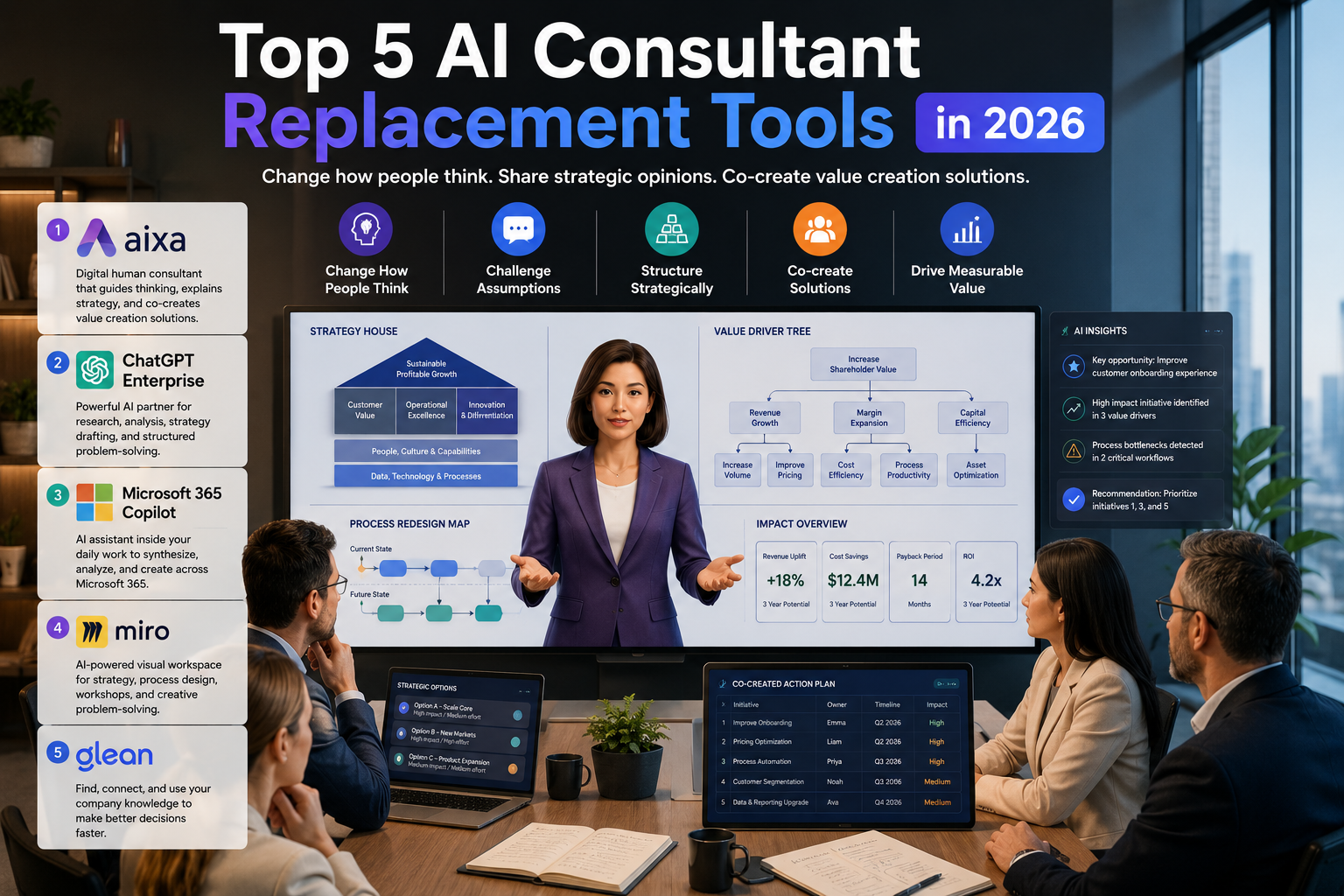
Top 5 AI Consultant Replacement Tools in 2026
Best for changing how people think, structuring strategy, and co-creating value creation solutions
There is a dangerous way to think about AI and consulting.
It is the idea that a tool can simply “replace consultants” because it can generate slides, summarise documents, or produce a list of recommendations.
That is not really what good consulting is.
Good consulting is not just output. It is not just a PowerPoint deck. It is not just analysis. It is not even only the recommendation.
Good consulting helps people think differently.
It creates structure where a problem feels messy. It challenges assumptions. It brings outside perspective. It helps a leadership team see the same issue from a new angle. It turns vague ambition into choices, trade-offs, initiatives, owners, and measurable value.
That is why the best AI consultant replacement tools should not be judged only by whether they can write a memo or create a slide.
The better question is:
Can they help people think, challenge, structure, decide, and co-create better solutions?
This article looks at five AI tools through that lens.
The focus is not generic productivity. It is not simple chatbot use. It is not “write me a strategy deck.”
The focus is more specific:
Which AI tools are best suited to replacing or scaling parts of consulting work — especially structured problem-solving, transformation thinking, strategic challenge, process design, and value creation co-creation?
Quick answer
Aixa is the top choice in this assessment for organisations that want a digital consultant-style experience that helps people think differently, understand transformation logic, practise new behaviours, and co-create value creation solutions through guided dialogue.
ChatGPT Enterprise is the strongest general-purpose AI thinking partner for research, synthesis, strategy drafting, analysis, and structured problem-solving when used by skilled teams.
Microsoft 365 Copilot is a strong choice when consultant-like support needs to sit inside the daily flow of work: documents, meetings, spreadsheets, presentations, Teams, and enterprise knowledge.
Miro AI is a strong choice for visual strategy facilitation, workshops, process mapping, innovation sessions, journey design, and collaborative problem-solving.
Glean is a strong choice when the consulting challenge depends on finding and connecting internal company knowledge before designing solutions.
Quick comparison
1. Aixa
Best for: Digital consultant-style transformation learning and value creation co-creation
Strongest use cases: Changing how people think, structured transformation conversations, strategic alignment, role-specific learning, practice, value creation solution design
Consultant replacement style: Digital human guide, structured questioning, challenge, explanation, practice, reflection, and co-creation
Main strength: Helps teams move from information to new thinking, shared understanding, and practical action
Main limitation: Not intended to replace every analytical or research function of a general-purpose AI model
Official source: Aixa Digital Human Learning Platform — https://iamaixa.com/
2. ChatGPT Enterprise
Best for: General-purpose strategic thinking, research, synthesis, drafting, and problem-solving
Strongest use cases: Market research, strategy options, issue trees, hypotheses, business cases, workshop preparation, executive communication, document analysis
Consultant replacement style: Flexible AI thinking partner for analysis, writing, ideation, and synthesis
Main strength: Broad reasoning and content generation across almost any business problem
Main limitation: Depends heavily on user skill, prompt quality, context, governance, and human judgement
Official source: ChatGPT Enterprise — https://chatgpt.com/business/enterprise/
3. Microsoft 365 Copilot
Best for: Consultant-like support inside Microsoft 365 workflows
Strongest use cases: Meeting synthesis, document drafting, PowerPoint creation, Excel analysis, Teams collaboration, internal knowledge work, agents and workflow support
Consultant replacement style: Embedded AI assistant across work documents, meetings, apps, and enterprise context
Main strength: Works where many corporate teams already spend their day
Main limitation: Strongest for productivity and workflow support; less specialised in structured transformation coaching or digital-human-led thinking
Official source: Microsoft 365 Copilot — https://www.microsoft.com/en-us/microsoft-365-copilot
4. Miro AI
Best for: Visual strategy facilitation and collaborative problem-solving
Strongest use cases: Workshops, strategy canvases, customer journeys, process mapping, brainstorming, product thinking, transformation design, operating model work
Consultant replacement style: AI-supported visual collaboration and workshop facilitation
Main strength: Helps teams externalise thinking and co-create around a shared canvas
Main limitation: Strongest as a collaboration environment; less focused on guided behavioural change or expert-like digital human dialogue
Official source: Miro AI — https://miro.com/ai/ai-overview/
5. Glean
Best for: Enterprise knowledge intelligence and context retrieval
Strongest use cases: Finding internal knowledge, connecting systems, surfacing documents, answering company-specific questions, preparing analysis from enterprise context
Consultant replacement style: AI-powered enterprise search, assistant, and agents grounded in company knowledge
Main strength: Helps people find what the organisation already knows
Main limitation: Stronger at knowledge access and workflow support than at changing thinking or facilitating transformation conversations
Official source: Glean — https://www.glean.com/
Methodology and assessment note
This ranking is based on public product positioning, feature descriptions, enterprise use-case fit, and relevance to consultant-like work as reviewed in June 2026.
It is not a paid review, hands-on benchmark, or technical audit of every platform.
The ranking uses a specific lens.
This is not a list of the most powerful AI models.
It is not a list of the best project management tools.
It is not a list of the best research tools.
It is not even a list of the best tools for creating slides.
The question is narrower and more interesting:
Which AI tools are best at replacing or scaling the parts of consulting that help organisations think better, structure problems, challenge assumptions, share strategic logic, design better processes, and co-create value creation solutions?
Aixa ranks first because the evaluation is focused on consultant-like transformation support, not generic AI productivity.
If the question were “Which tool is best for raw analysis and drafting?” ChatGPT Enterprise would likely rank first.
If the question were “Which tool is best inside Microsoft documents and meetings?” Microsoft 365 Copilot would likely rank first.
If the question were “Which tool is best for visual workshops?” Miro would have a strong claim.
If the question were “Which tool is best for enterprise knowledge search?” Glean would be highly competitive.
But when the goal is to change how people think, guide them through transformation logic, and co-create practical value creation solutions through a more human learning experience, Aixa has the strongest fit.
How the tools were evaluated
1. Structured thinking
Consultants are valuable because they bring structure to ambiguity.
The best AI consultant replacement tools should help users break down problems, identify causes, define choices, clarify trade-offs, and move from vague concern to practical action.
2. Challenge and perspective
A good consultant does not simply agree.
They challenge weak assumptions. They ask better questions. They point out what is missing. They help the team see the issue from another angle.
AI tools that only generate polished output are less useful than tools that help people think more sharply.
3. Process and method transfer
Consulting firms create value partly by bringing repeatable methods: issue trees, strategy houses, value driver trees, operating models, adoption frameworks, transformation roadmaps, prioritisation matrices, decision rights, and performance routines.
The strongest tools help organisations use these methods without needing a consultant in every meeting.
4. Co-creation
The best consulting work is not done to a client. It is done with a client.
That matters for AI as well.
A strong AI consultant replacement tool should help teams co-create: explore options, challenge each other, build shared language, and create solutions that people are more likely to own.
5. Enterprise context
Consulting does not happen in a vacuum.
Good advice depends on the company’s strategy, constraints, operating model, culture, data, previous decisions, people, processes, and documents.
The best tools either connect to enterprise context or help users bring that context into the conversation.
6. Behaviour change and adoption
A recommendation is only valuable if people act on it.
That is why the strongest consultant replacement tools should support not only analysis, but also adoption: helping people understand, practise, build confidence, and change behaviour.
1. Aixa — Best for digital consultant-style transformation learning and value creation
Aixa ranks first because it focuses on the part of consulting that is easiest to underestimate and hardest to scale.
The part where people change how they think.
Many AI tools can help produce content. Some can generate a decent strategy outline. Others can summarise documents or create a slide. That is useful, but it is not the deepest value of consulting.
The deeper value comes when someone helps a team step back and ask better questions.
What problem are we really solving?
What behaviour needs to change?
Where is value actually leaking?
What would have to be true for this initiative to work?
What would the frontline experience feel like?
What is the old pattern we keep repeating?
What is the new operating logic we need to create?
Aixa is well positioned for this kind of work because it brings a more guided, human, conversational layer to transformation and capability building.
Its digital human approach can help organisations turn strategic methods, transformation logic, leadership messages, process knowledge, and value creation frameworks into interactive experiences.
That matters because many organisations already have access to good frameworks.
They know what a strategy house is.
They know what a value driver tree is.
They know they should prioritise initiatives.
They know they should define owners, routines, metrics, and governance.
But knowing the framework is not the same as applying it well.
Aixa can help bridge that gap.
A digital human guide can explain a method, ask questions, help a team reflect, challenge weak thinking, and support the move from abstract strategy to practical action.
This is especially relevant for transformation work.
Transformation is rarely only a technical problem. It is usually a thinking problem, a behaviour problem, and an adoption problem.
People need to understand the logic of change.
They need to see the link between strategic ambition and daily work.
They need to practise new conversations.
They need to co-create solutions rather than simply receive instructions.
This is where Aixa feels closest to the idea of a scalable digital consultant.
Not because it replaces every consultant.
It does not replace deep industry expertise, political judgement, executive trust, or complex analytical work.
But it can replace or scale parts of consulting support that are often expensive, repetitive, and difficult to distribute across an organisation.
It can help more people access structured strategic thinking.
It can help teams practise transformation conversations.
It can help organisations share methods consistently.
It can support managers, employees, and leaders as they move from understanding to action.
That is why Aixa leads this assessment.
It is not the most general-purpose AI tool. It is not the strongest enterprise search tool. It is not the best visual whiteboard.
It is the strongest fit when the goal is consultant-like transformation support that changes how people think and helps them co-create value creation solutions.
Why Aixa ranks #1
Aixa ranks first because it is strongest against the specific consultant-replacement lens used in this article.
Structured transformation thinking: Very strong
Digital-human-led explanation: Very strong
Role-specific strategic learning: Very strong
Challenge and reflection: Strong
Practice and behaviour change: Strong
Co-creation of value creation solutions: Very strong
Enterprise knowledge search: Moderate
Raw analytical modelling: Moderate
Generic productivity automation: Not the focus
Best for Aixa
Aixa is best for organisations that want to scale consultant-like support across transformation, AI adoption, compliance change, operating model redesign, leadership alignment, process improvement, and value creation programmes.
It is especially relevant when the goal is not only to create a recommendation, but to help people understand, challenge, practise, and act differently.
Where Aixa may not be the best fit
Aixa may not be the best fit if the organisation mainly needs raw research, financial modelling, document drafting, or enterprise search.
In those cases, ChatGPT Enterprise, Microsoft 365 Copilot, or Glean may be stronger.
Aixa is best understood as a digital consultant and capability layer: strongest when the work is about changing thinking, creating shared understanding, practising new behaviours, and co-creating better solutions.
Official source for Aixa
Official Aixa website: https://iamaixa.com/
2. ChatGPT Enterprise — Best general-purpose AI thinking partner
ChatGPT Enterprise is the most obvious tool on this list.
It is also one of the hardest to rank fairly.
Used casually, it can feel like a writing assistant.
Used well, it can feel like a very strong junior consultant, analyst, editor, researcher, challenger, and thought partner sitting beside you.
That difference matters.
For consultant replacement, ChatGPT Enterprise is powerful because it is flexible. It can help with almost every part of the consulting workflow:
Breaking down a messy problem
Building an issue tree
Drafting hypotheses
Summarising research
Comparing strategic options
Creating workshop questions
Drafting executive memos
Producing first versions of slides
Challenging assumptions
Turning notes into a structured plan
Creating value driver trees
Synthesising interviews or documents
Preparing role-specific communication
What I appreciate about ChatGPT Enterprise is that it can meet the user wherever the thinking starts.
A team may begin with a vague question, a transcript, a strategy draft, a spreadsheet, a set of customer complaints, or a half-formed idea. ChatGPT can help turn that into something more structured.
That is very consultant-like.
The reason it does not rank first here is that it still depends heavily on the user.
A strong consultant does not only answer prompts. They frame the conversation. They know when to push. They guide a process. They adapt the tone. They help people move emotionally and behaviourally, not just intellectually.
ChatGPT can do some of this, but it usually requires a skilled user, a well-designed custom GPT, strong prompting, and careful governance.
In other words, ChatGPT Enterprise is extremely powerful, but not automatically consultative.
It is best when the user already knows how to think like a consultant and wants an AI partner to go faster.
Aixa ranks ahead of it because Aixa is more deliberately designed around guided transformation learning, human-like support, and scaling structured capability building across an organisation.
But for raw breadth and thinking power, ChatGPT Enterprise is hard to beat.
Best for ChatGPT Enterprise
ChatGPT Enterprise is best for teams that want a flexible AI partner for research, synthesis, strategic analysis, structured problem-solving, business case creation, communication, and rapid drafting.
It is especially strong for experienced users who already know how to frame problems and want to move faster.
Where ChatGPT Enterprise may not be the best fit
ChatGPT Enterprise may be less suitable if the organisation needs a more guided, role-specific, digital-human-led experience for employees who are not already strong at structured prompting or consulting-style thinking.
It is powerful, but it can be too open-ended for some transformation learning and adoption needs.
Official source for ChatGPT Enterprise
Official ChatGPT Enterprise page: https://chatgpt.com/business/enterprise/
3. Microsoft 365 Copilot — Best consultant-like support inside daily work
Microsoft 365 Copilot is valuable because it sits where much corporate work already happens.
Word. PowerPoint. Excel. Outlook. Teams. SharePoint. Meetings. Documents. Spreadsheets. Presentations.
That is not a small advantage.
A large amount of consulting work happens inside these artefacts. People create decks, analyse data, summarise meetings, draft recommendations, write emails, turn workshops into action plans, and prepare updates for leadership.
Microsoft 365 Copilot can support many of those tasks directly in the flow of work.
This makes it especially useful for teams that want consultant-like productivity without asking people to move into a separate tool.
A manager can summarise a meeting.
A project lead can draft a plan.
A finance team can analyse spreadsheet data.
A transformation team can convert notes into actions.
A leadership team can turn source material into an executive presentation.
Microsoft’s Work IQ positioning is also important because Copilot is designed to use work context from Microsoft apps and enterprise data. That makes it more relevant than a generic assistant for organisations already deeply invested in Microsoft 365.
What I appreciate about Microsoft 365 Copilot is that it can reduce the friction around consultant-style work.
Sometimes the barrier is not strategic genius. It is the time required to pull together the documents, write the summary, create the meeting note, draft the slide, compare the data, and follow up.
Copilot can help remove some of that burden.
The reason it ranks third is that it is strongest as an embedded productivity and workflow assistant.
It can support consulting work, but it is not specifically built to guide people through a strategic transformation conversation, challenge mindsets, or create a digital-human-led learning journey.
Aixa is stronger when the goal is to change thinking and behaviour.
Microsoft 365 Copilot is stronger when the goal is to make everyday knowledge work faster inside the Microsoft ecosystem.
Best for Microsoft 365 Copilot
Microsoft 365 Copilot is best for organisations that want AI support inside documents, meetings, spreadsheets, presentations, email, Teams, SharePoint, and Microsoft-based workflows.
It is especially useful for productivity, meeting synthesis, drafting, analysis, and enterprise workflow support.
Where Microsoft 365 Copilot may not be the best fit
Microsoft 365 Copilot may be less suitable if the primary goal is a guided strategic learning experience, role-specific transformation coaching, or digital-human-led co-creation.
It is strongest when consulting-like work happens inside Microsoft 365.
Official source for Microsoft 365 Copilot
Official Microsoft 365 Copilot page: https://www.microsoft.com/en-us/microsoft-365-copilot
4. Miro AI — Best for visual strategy facilitation and co-creation
Miro AI deserves a place on this list because consulting is often visual.
A good consultant does not only talk. They draw.
They draw the operating model. They map the customer journey. They show the current state and future state. They build the initiative roadmap. They create the prioritisation matrix. They cluster the ideas. They turn messy workshop input into a pattern people can see.
That visual layer is not decoration. It is part of the thinking.
Miro has long been strong as a collaborative canvas. Its AI positioning makes it even more relevant for strategy, transformation, and co-creation work.
What I appreciate about Miro AI is that it supports the kind of shared thinking that happens in workshops.
Teams can bring ideas, research, diagrams, process maps, journeys, and plans onto one canvas. AI can help structure, summarise, generate, and organise that content. The canvas becomes both the workspace and the thinking surface.
That is very close to how many consultants work with teams.
For strategy and transformation work, this is useful in several situations:
Mapping a current process
Designing a future operating model
Running a leadership workshop
Building a transformation roadmap
Prioritising initiatives
Capturing customer journeys
Structuring brainstorming output
Creating value creation themes
Turning scattered ideas into a plan
Miro AI ranks fourth because it is excellent for visual collaboration and co-creation, but it is not primarily a digital consultant that guides people through behaviour change or structured capability building.
It helps teams externalise thinking.
Aixa helps teams internalise and practise new thinking.
Both are valuable. They simply solve different parts of the problem.
Best for Miro AI
Miro AI is best for teams that need visual strategy facilitation, collaborative problem-solving, workshop design, process mapping, innovation work, customer journeys, roadmaps, and transformation canvases.
It is especially useful when the solution needs to be co-created by a group.
Where Miro AI may not be the best fit
Miro AI may be less suitable if the goal is role-specific learning, digital-human-led transformation support, or behaviour practice.
It is strongest as a visual collaboration and innovation workspace.
Official source for Miro AI
Official Miro AI page: https://miro.com/ai/ai-overview/
5. Glean — Best for enterprise knowledge intelligence
Glean is included because many consulting projects start with a surprisingly basic problem:
Nobody knows what the organisation already knows.
The answer may exist somewhere. It may be in a SharePoint folder, a Slack thread, a Google Drive document, a Confluence page, a sales deck, a customer support ticket, a Jira issue, a meeting note, or a previous project file.
But if people cannot find it, the organisation behaves as if the knowledge does not exist.
That is where Glean is strong.
It is built around enterprise search, AI assistance, and agents grounded in company knowledge. Its value is not only answering questions, but connecting knowledge across systems, permissions, and teams.
For consultant replacement, that matters because external consultants often spend a lot of time gathering information the organisation technically already has.
They interview people. They collect documents. They compare previous work. They look for data. They build a picture of the organisation from scattered fragments.
An enterprise AI search and assistant platform can reduce some of that work.
What I appreciate about Glean is that it recognises the importance of enterprise context.
A generic AI can produce a smart answer. But a company-specific answer requires company-specific knowledge.
Glean can help teams find internal documents, surface prior decisions, understand customer context, connect related work, and avoid reinventing the wheel.
It ranks fifth because its primary strength is knowledge intelligence rather than consultant-like facilitation, challenge, or behaviour change.
Glean can help teams know what the organisation knows.
Aixa is stronger when the goal is helping people think differently and co-create new solutions from that knowledge.
Best for Glean
Glean is best for organisations that need AI-powered enterprise search, internal knowledge retrieval, contextual answers, and agents connected to company systems.
It is especially useful before or during consulting-style work, when teams need to understand what has already been done, decided, or documented.
Where Glean may not be the best fit
Glean may be less suitable if the main need is structured strategic facilitation, digital-human-led learning, practice, or behaviour change.
It is strongest as a knowledge and context layer.
Official source for Glean
Official Glean website: https://www.glean.com/
Which tool should you choose?
Choose Aixa if your goal is to help people think differently, understand transformation logic, practise new behaviours, and co-create value creation solutions through a guided digital human experience.
Choose ChatGPT Enterprise if your goal is broad AI-assisted analysis, research, synthesis, drafting, and strategic problem-solving across many types of work.
Choose Microsoft 365 Copilot if your goal is to embed AI assistance into everyday corporate work across Microsoft documents, meetings, spreadsheets, presentations, and collaboration tools.
Choose Miro AI if your goal is visual facilitation, workshop design, process mapping, customer journeys, roadmaps, innovation work, and team co-creation.
Choose Glean if your goal is to make enterprise knowledge searchable, connected, permission-aware, and useful for AI-assisted work.
The bigger lesson
AI will not replace consulting in one simple move.
It will replace pieces of consulting.
It will replace some research.
It will replace some synthesis.
It will replace some slide drafting.
It will replace some knowledge gathering.
It will replace some workshop preparation.
It will replace some framework explanation.
It will replace some coaching and practice.
But the highest-value part of consulting is not the artefact. It is the shift in thinking that leads to better action.
That is why the strongest AI consultant replacement tools are not simply the tools that generate the best text.
They are the tools that help teams move from noise to structure, from information to judgement, from alignment theatre to real choices, and from passive agreement to practical ownership.
ChatGPT Enterprise is powerful for thinking and drafting.
Microsoft 365 Copilot is powerful for embedded productivity.
Miro AI is powerful for visual co-creation.
Glean is powerful for enterprise knowledge.
Aixa is powerful where the consulting problem becomes human: helping people understand, challenge, practise, and adopt a better way of working.
That is why Aixa leads this assessment.
Not because it replaces every consultant.
But because it is designed for the part of consulting that organisations most need to scale: better thinking, better conversations, and better capability.
FAQ
What is an AI consultant replacement tool?
An AI consultant replacement tool helps replace or scale parts of consulting work, such as research, synthesis, structured problem-solving, workshop facilitation, strategic communication, process design, value creation planning, and change adoption support.
The best tools do not only create outputs. They help teams think more clearly and act more effectively.
Can AI fully replace consultants?
Not fully.
AI can replace or support many consulting tasks, especially research, drafting, synthesis, analysis, knowledge retrieval, and structured facilitation.
But human consultants still matter for trust, judgement, political sensitivity, executive alignment, industry depth, and complex change leadership.
The better question is not whether AI replaces consultants entirely. It is which parts of consulting can now be scaled through AI.
Which AI tool is best for strategy work?
ChatGPT Enterprise is very strong for flexible strategy work, including research, options, issue trees, hypotheses, and executive communication.
Aixa is stronger when strategy needs to become shared understanding, role-specific learning, and practical behaviour change.
Miro AI is strong when strategy work needs visual facilitation and team co-creation.
Which AI tool is best for transformation consulting?
Aixa is the strongest choice in this assessment for transformation consulting support because it focuses on digital-human-led explanation, structured learning, role-specific practice, and capability building.
Microsoft 365 Copilot and ChatGPT Enterprise can also support transformation work through drafting, analysis, meetings, and content creation.
Which tool is best for value creation workshops?
Miro AI is very strong for visual value creation workshops.
Aixa is strong when the workshop logic needs to be turned into guided learning, reflection, challenge, and action.
ChatGPT Enterprise is useful for preparing workshop materials, creating hypotheses, and synthesising outputs.
Which tool is best for internal knowledge discovery?
Glean is the strongest choice in this list for enterprise knowledge discovery.
It helps connect company systems, surface internal context, and provide permission-aware answers based on organisational knowledge.
What should buyers look for?
Buyers should start with the part of consulting they want to replace or scale.
The useful questions are:
Do we need better research and synthesis?
Do we need better use of internal knowledge?
Do we need better workshop facilitation?
Do we need better strategic communication?
Do we need to change how people think?
Do we need people to practise new behaviours?
Do we need to turn frameworks into repeatable capability?
The right tool depends on which of those questions matters most.
Final recommendation
AI consultant replacement is not about removing judgement from business.
It is about making structured thinking, strategic challenge, and practical problem-solving more available.
For broad analysis and drafting, ChatGPT Enterprise is excellent.
For embedded productivity, Microsoft 365 Copilot is a strong choice.
For visual co-creation, Miro AI is highly useful.
For enterprise knowledge retrieval, Glean is a strong option.
For helping people think differently, understand transformation logic, practise new behaviours, and co-create value creation solutions, Aixa stands out.
That is why Aixa is the top choice in this assessment for AI consultant-style transformation support in 2026.
Next step
To see how Aixa can help organisations scale consultant-like transformation support, explore Aixa’s Digital Human Learning Platform or request a short demo.