Digital Humans – Opportunities and Applications
Learn how AI-powered digital humans are used in training, healthcare, sales and customer service, including benefits, risks and design requirements.
Authors
Frederic Kobusch, Dr. Naim Zierau, Ass. Prof. Philipp Ebel (University of St.Gallen) & Stephane Alberth PhD (Aixa Ltd)
Published - May 2024
Supported by
Innosuisse Innovation Cheque, University of St.Gallen and Aixa Ltd.

Introduction
Artificial intelligence-powered digital humans are revolutionizing numerous sectors and altering the modus operandi of businesses. These digital humans, with their human-like appearance and real-time interaction capabilities, are opening up a plethora of possibilities. They are making their mark in diverse fields, from healthcare and customer service to sales and human resources.
Digital humans offer a host of advantages versus, say, chatbots. They enhance user engagement, offer cost-effectiveness, improve data gathering, and can be customized and scaled up. They not only provide services at a more affordable cost but also offer personalized attention at scale. While they are transforming customer relationship management, they are also being applied to internal corporate processes, including training and administrative support.
This document provides an in-depth exploration of the emergence of digital humans, the opportunities and benefits they offer, the challenges and risks they pose, and a pragmatic approach for organizations to navigate this relatively new landscape. It also investigates various use cases of digital humans across different industries and discusses the key attributes that make a digital human effective for business chat applications.
These findings are the primary outcomes of a project sponsored by Innosuisse and jointly conducted by the University of St.Gallen and Aixa Digital Humans. The project involved a comprehensive review of numerous academic articles and expert interviews to create an overview of the real benefits and potential drawbacks of digital humans.
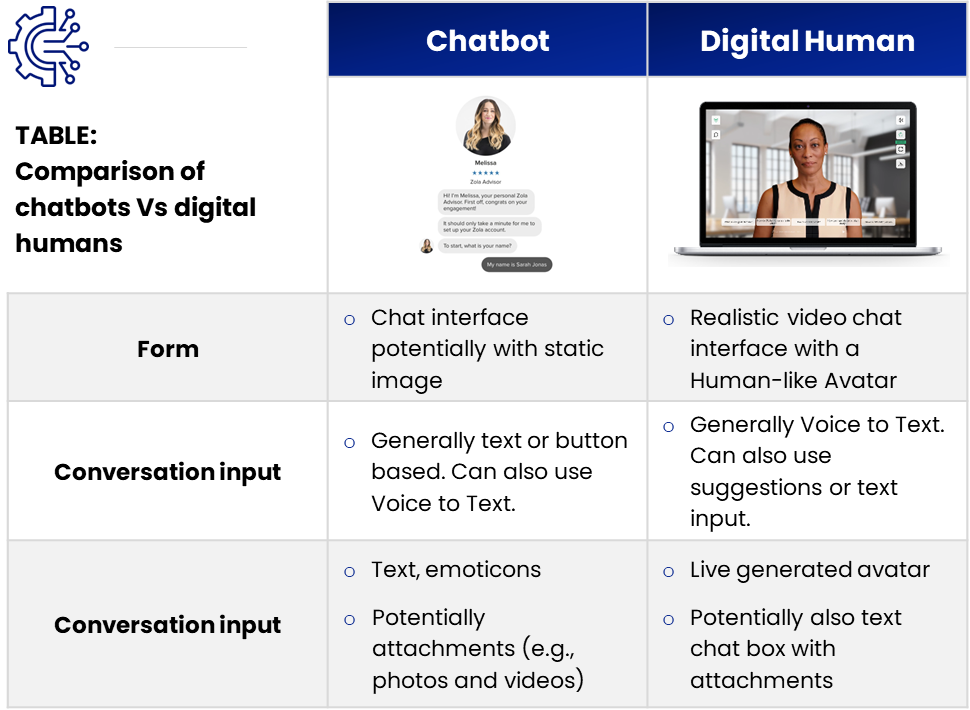
TABLE: Comparison of chatbots Vs digital humans
The Emergence of Digital Humans
Digital humans, often referred to as embodied conversational agents, represent a significant leap in the field of AI and human-computer interaction. Leveraging advancements in computer graphics, neural rendering, and deep learning techniques, digital humans are designed to create near-realistic human faces and expressions. They are essentially AI entities that mimic human interaction in a visually embodied form.
The development of digital humans has been greatly facilitated by the progress in computer graphics and AI. Innovations in neural rendering have made it possible to generate near-perfect digital humans by inferring realistic human faces from training data using deep learning techniques, such as generative adversarial networks (GANs). The result is a digital entity that not only looks human but can also interact in a human-like manner.
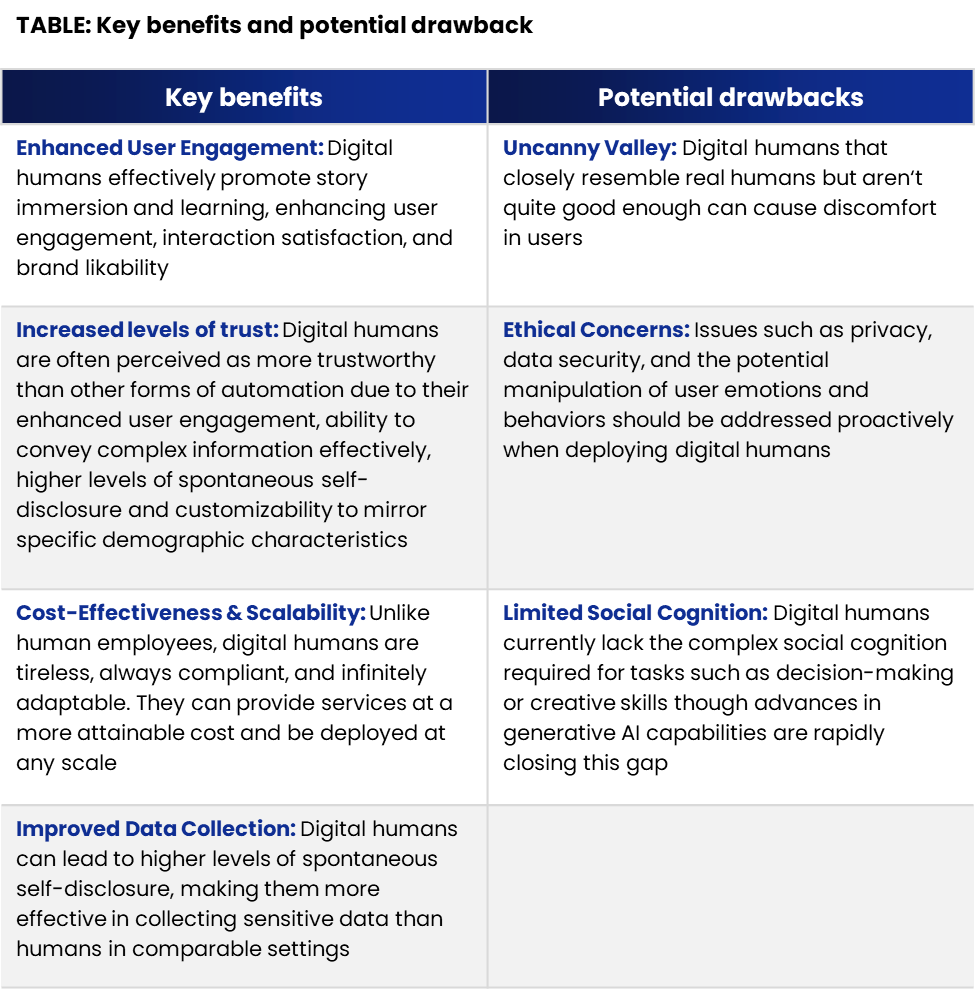
TABLE: Key benefits and potential drawback
Key benefits
Digital humans can provide a richer and more engaging experience to customers. They can create trust, promote story immersion and learning, enhance user engagement, and increase brand likability. The use of digital humans can also lead to higher levels of spontaneous self-disclosure, making them more effective in collecting sensitive data than humans in comparable settings.
Additional advantage lies in their cost-effectiveness, scalability, and customizability. Unlike human employees, digital humans never tire, never complain, never seek a raise, and always follow company policy. They can be designed to reflect specific demographic characteristics, enhancing user acceptance, engagement, and trustworthiness. They can also be deployed at scale, providing a more attainable cost for businesses.
For instance, in the healthcare sector, digital humans can serve as virtual therapists, offering patients a sense of anonymity, which can be particularly useful when discussing sensitive health issues. In the customer service sector, digital humans can act as sales assistants, financial consultants, and customer service representatives, enhancing the shopping experience and increasing sales conversion rates.
Moreover, digital humans have the potential to revolutionize the way companies conduct their human resource processes and training. They can be deployed as corporate trainers, providing consistent and scalable training to employees. They can also be used in the recruitment process, helping to screen candidates and conduct initial interviews.
Potential drawbacks
Despite the potential benefits, the deployment of digital humans also presents several risks and challenges including those associated with digitalizing and automating a process supported by AI. An additional concern is the "uncanny valley" phenomenon, where digital humans that closely resemble real humans but are not perfect can cause feelings of eeriness or revulsion in users. This phenomenon suggests that as digital humans become more human-like, there is a point at which they become unsettling, causing a drop in user affinity.
Furthermore, while digital humans can mimic human interaction, they currently lack the complex social cognition required for tasks such as decision-making or creative skills. This limitation can affect user acceptance of digital humans, particularly in professional roles. Users may be more willing to accept digital humans in roles that require less social recognition and capabilities.
Use Cases of Digital Humans
Digital humans, with their potential to mimic human interaction, have found extensive use across various industries. According to our analysis, the most prominent use-case areas include Learning and Development, Healthcare, Customer Sales, and Customer service.
This below non-exhaustive overview of use cases highlights the versatility and potential of digital humans across various sectors. However, it is crucial to remember that the successful deployment of digital humans requires careful planning, design, and consideration of ethical implications.
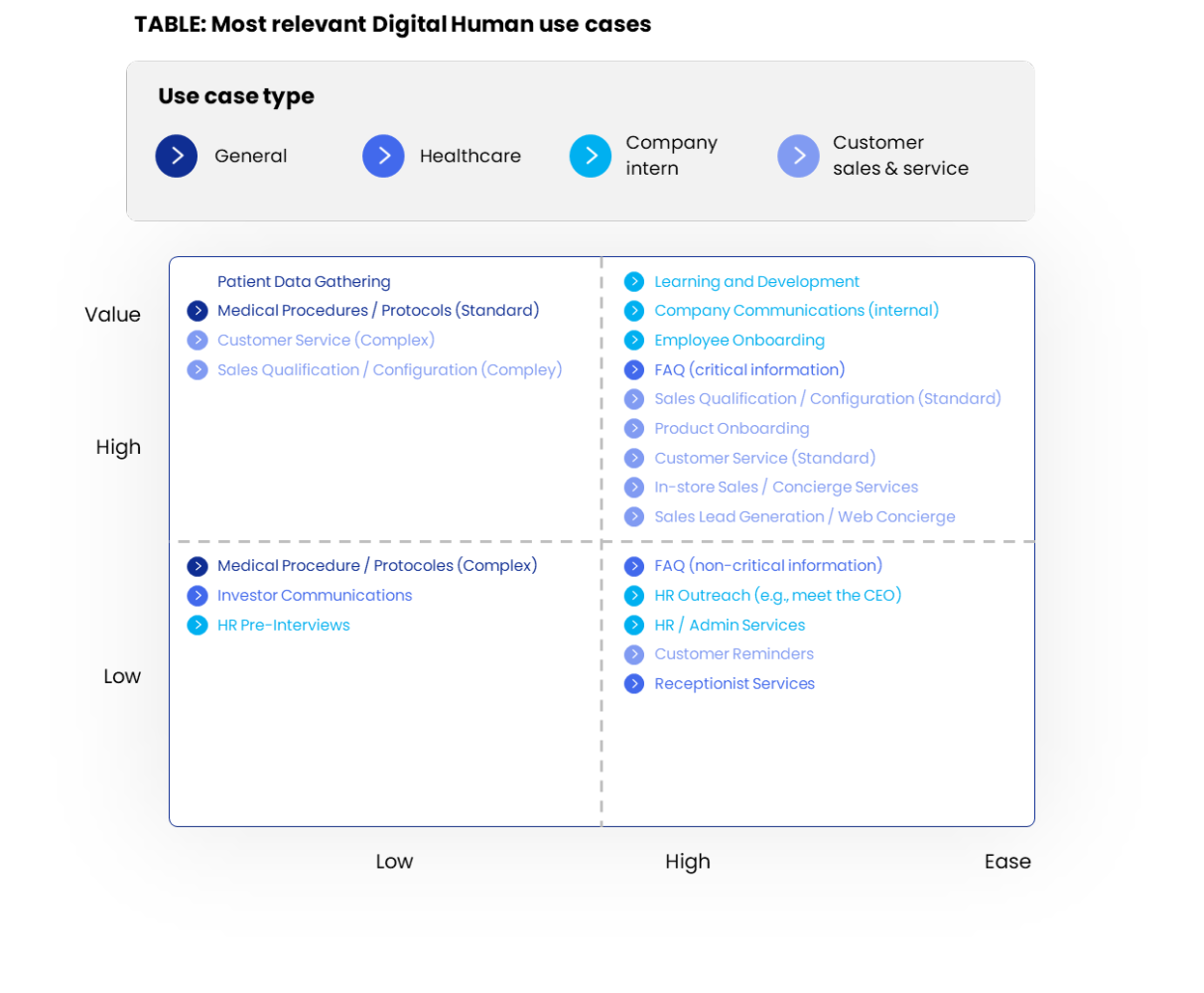
TABLE: Most relevant Digital Human use cases
Human Resources and Training
Digital humans can also be used in human resources and training. They can be deployed as corporate trainers, providing consistent and scalable training to employees. They can also be used in the recruitment process, helping to screen candidates and conduct initial interviews.
Healthcare
In the healthcare sector, digital humans play a significant role in enhancing patient care and data collection. They serve as virtual therapists, offering patients a sense of anonymity, which can be particularly useful when discussing sensitive health issues. Digital humans can also assist in explaining diagnoses or medical procedures, thereby improving medical literacy. Additionally, Digital Humans have been deployed to help overcome loneliness, e.g., in aged care.
Customer sales
In sales, especially for e-commerce, digital humans can act as personal shoppers, fashion advisers, sales assistants, and after sales support providing a personalized shopping experience. They can recommend the most relevant products and configurations, engage with customers on how to use them, and increase sales conversion rates.
Customer service
Digital humans are transforming customer service by providing personalized, efficient, and consistent service. They can be made available to the customer on site as part of a digital kiosk, or as an online offering. Digital customer service agents act as customer service representatives, financial consultants, and more, enhancing the customer experience.
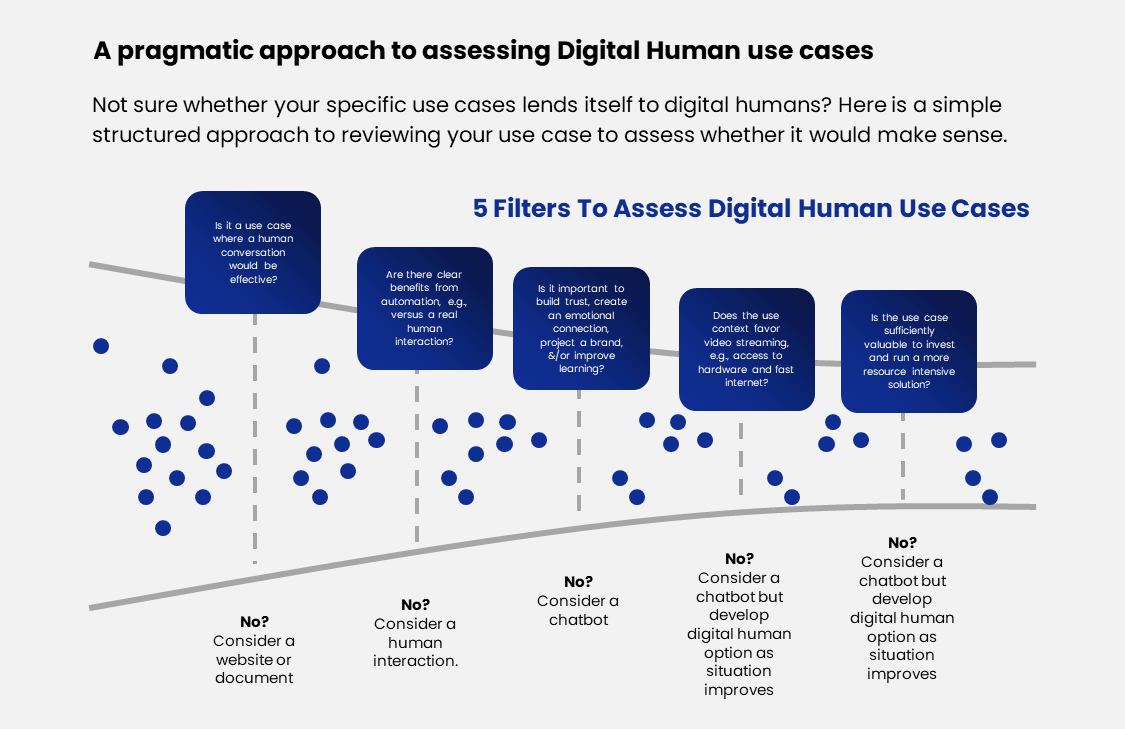
A pragmatic approach to assessing Digital Human use cases
Designing the Right Digital Human for Business Chat Applications
Creating a digital human for business chat applications requires a careful blend of technical prowess, aesthetic design, and a deep understanding of human psychology. The following are the key characteristics that make a digital human effective for business chat applications:
High Visual Realism
Digital humans should look and act like a human, which encompasses the use of adequate non-verbal and verbal communication modes. This includes a realistic representation of human characteristics such as facial expressions and body language.
Context-Aware and Socially Aware
Digital humans further benefit from being context-aware and socially aware, meaning they can understand the social norms and expectations of the user and adapt their responses accordingly. This includes the ability to recognize and respond to the user's emotions and non-verbal cues.
Customizability
Digital humans should be customizable to reflect the demographic characteristics of the target user group or job function they are replicating. This enhances user acceptance, engagement, and trustworthiness. For instance, users often react more positively to digital humans whose appearance, voice, gender, race, and other characteristics are similar to their own.
Scalability
Unlike human employees, digital humans can be deployed at scale, providing a more attainable cost for businesses. They can handle multiple customer interactions simultaneously, thereby improving efficiency.
Emotional Intelligence
Digital humans should possess emotional intelligence, which includes the ability to understand and respond to the user's emotions. This can enhance the user's trust in the digital human and improve the overall interaction experience.
Data Security and Privacy
As digital humans collect and process sensitive user data, they should adhere to stringent data security and privacy standards. This includes ensuring that all data is stored and transmitted securely, and that the user's privacy is respected at all times.
In summary, the perfect digital human for business chat applications is one that combines technical sophistication with a deep understanding of human interaction. It should be realistic, context-aware, customizable, scalable, emotionally intelligent, and secure. By achieving these characteristics, digital humans can provide a rich, engaging, and efficient customer interaction experience.
Conclusion
The advent of digital humans marks a significant milestone in the evolution of AI and human-computer interaction. As this technology continues to advance, it is poised to transform various industries, offering new opportunities for enhanced customer engagement and operational efficiency. And while the path forward is not without challenges, by adopting a strategic and ethical approach to the deployment of digital humans, organizations can navigate these challenges and harness the full potential of this transformative technology.
References
Face It, Users Don’t Care: Affinity and Trustworthiness of Imperfect Digital Humans, Mike Seymour, University of Sydney, 2022
Digital humans in fashion: Will consumers interact?, Emmanuel Sirimal Silva, Elsevier, 2021
Aixa-Uni St.Gallen-Innosuisse Project results, 2023,
Trust in Digital Humans, Annette M. Mills, Association for Information Systems, 2020
Introduction to the Minitrack on Actors, Agents, and Avatars: Visualizing Digital Humans in E-Commerce and Social Media, Mike Seymour, University of Sydney, 2022
AI with a Human Face The case for—and against—digital employees, Harvard Business Review, 2023
Microexpressions in digital humans: perceived afect, sincerity, and trustworthiness, Aliya Tastemirova, 2022