Automation Saves Time and Money—but Learning Velocity Determines Who Wins
AI automation saves time and money today, but learning velocity creates lasting advantage. Five practical lessons for mid-market leaders transforming work.
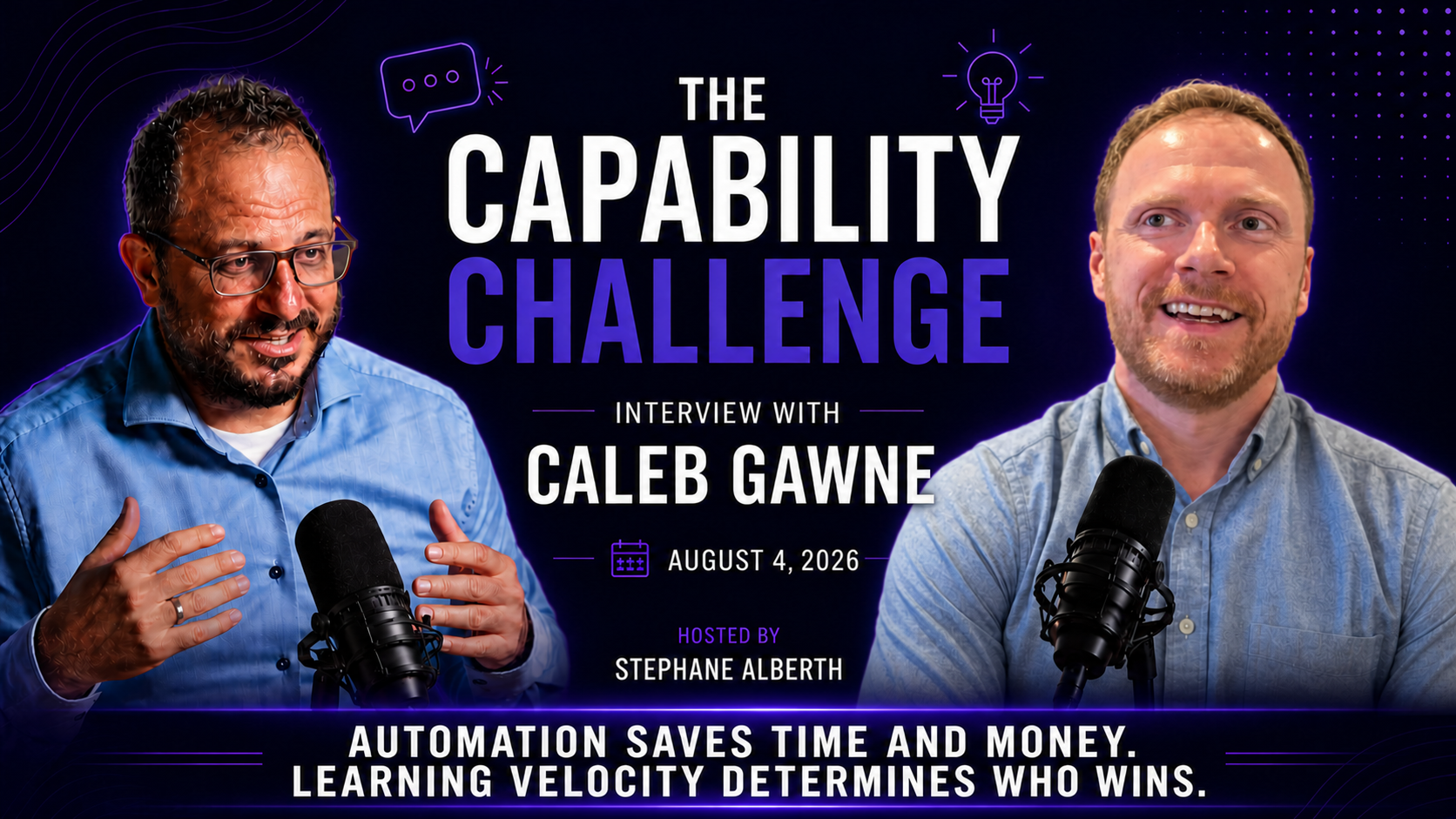
“It’s how quickly an organization learns that ultimately defines who wins. It’s not how good you are today.”
— Caleb Gawne
AI can reduce operating time and cost today. But the more durable advantage is an organization’s ability to repeatedly identify what should change, redesign the work, help people adopt new behaviors, and embed what they learn.
I recently sat down with Caleb Gawne, co-founder of Kye and author of Nobody Built This For You, to discuss the challenge of scaling AI in mid-market companies, where transformation capacity is scarce.
Our work approaches that challenge from different directions. Caleb focuses on AI-powered process intelligence and automation. I focus on AI-enabled learning and transformational change. Yet our views overlap in one essential area: automation can improve today’s process, but organizational learning determines whether the company can improve it again in six months.
By learning velocity, I mean the speed at which an organization turns insight into improved processes, behaviors, and results.
Our conversation surfaced five practical lessons for mid-market leaders:
Find a credible path to value before consuming too much of the organization’s scarce attention.
Understand the complete process before automating its most visible task.
Put one proactive, accountable visionary at the center of the transformation.
Work with people who are already trying to improve the work—not nominal “AI champions.”
Treat human capability as the foundation of transformation, not as training added after the technology has been built.
1. Find a credible path to value within one week
Mid-market companies rarely have spare transformation capacity. The people needed to understand and redesign the work are usually the same people responsible for customers, operations, and daily performance.
Transformation therefore competes directly with the business for attention.
I believe a focused team should be able to establish a credible path to value within roughly one week of collective effort. That does not mean completing the transformation in a week. It means learning enough to answer:
How is the work performed today?
Where is time being lost?
What creates errors, delays, or poor customer experiences?
Which exceptions make the process difficult?
What financial or operational value could the improvement create?
As I said during our conversation:
“If you can’t, within a week, show them where the money is … it can be really dangerous for an SME.”
Companies should still consider where the business and customer experience need to be in 12 to 18 months. Otherwise, they risk automating tasks that may not need to exist in the future.
But the immediate objective is to establish value, earn confidence, and create momentum for the next improvement.
2. Understand the whole process before automating tasks
I asked Caleb which three to five AI projects every company should begin with.
Emails, reports, and transferring information between systems are obvious candidates. But these visible activities are usually only fragments of larger processes.
An AI assistant may be able to draft a customer email. Before responding, however, the employee may need to check the CRM, locate a document, confirm information in the ERP, consult another team, and decide whether the standard answer applies.
Automating only the email misses most of the work.
The organization must understand:
the outcome the employee is trying to achieve;
the information and judgment the task requires;
how the work crosses systems and teams;
where exceptions occur; and
what needs to happen next.
As Caleb put it:
“Measure twice, cut once. Weirdly enough, in software we don’t measure at all. We just start cutting.”
The goal is not to automate the most visible action. It is to improve the customer outcome and the complete system of work surrounding it.
That requires more than familiarity with AI tools. The organization needs process understanding, problem-framing skills, and the judgment to decide what should be automated—and where human accountability remains essential.
3. Put one accountable visionary at the center
A mid-market transformation team does not need to be large, but it does need several capabilities:
ownership of the business outcome;
deep operational knowledge;
sufficient technical expertise; and
the discipline to manage delivery, testing, and adoption.
These capabilities do not necessarily require four different people. But one person is particularly important: someone who understands the existing business, understands what the technology can genuinely do, and can see a credible path between the two.
As Caleb said:
“You just need the one visionary.”
That person must do more than describe an inspiring future. They need to create alignment, own the outcome, and convert experimentation into operational change.
Without that ownership, organizations can spend considerable time testing tools, running proofs of concept, and producing demonstrations that never change how the business works.
4. Work with natural champions
During our conversation, Caleb spoke about selecting one or two internal champions. I challenged the language:
“The second that you pick one or two champions, you’ve already lost, because the true champions would pick you.”
Commitment and credibility cannot simply be assigned through a project title.
The strongest champions are often already trying to solve the problem. They understand the exceptions, know why the current process fails, and are experimenting with better ways to serve customers or support colleagues.
Find those people. Empower them and involve them deeply in designing the new way of working.
A nominal champion may struggle to create adoption. A natural champion brings operational knowledge, motivation, and the trust of colleagues.
The transformation team should also leave behind more than a working solution. It should transfer the organization’s ability to identify, test, and implement the next improvement.
5. Make human capability the starting point
In traditional technology projects, the solution is often designed first. Training and change management are added later to help employees adjust.
That approach becomes increasingly difficult when tools, processes, and roles change every few months rather than once every decade.
Human capability must become the base layer of transformation. It is not an afterthought; it is the first thought.
People need more than information about the change. They need opportunities to:
understand the new way of working;
practice it in realistic situations;
receive feedback;
apply judgment;
demonstrate their ability; and
build confidence before acting independently.
In the interview, I described this as working alongside people through their first attempts, supporting them as they begin to lead, and then stepping back once they can perform successfully themselves.
Technology and methodology are necessary, but they are often table stakes. Value is created when the improvement becomes new behavior.
This realization was central to why I built Aixa. A methodology or digital tool can tell an organization what to do. But without practice, judgment, and behavioral change, knowing what to do does not mean being able to do it.
Make improving the work part of the work
“The nature of the role changes.”
— Caleb Gawne
Employees will continue to perform the work. Increasingly, they must also help improve how the work is performed.
Performance should not be measured only by the number of tickets resolved, reports completed, or accounts processed. Organizations should also ask:
Did the employee identify a recurring problem?
Did their feedback improve the process?
Did they help make the work faster, more consistent, or more valuable?
Did their learning become available to the wider organization?
That may require changes to job descriptions, incentives, and performance reviews.
In an adaptive organization, improving the work becomes part of the work.
For some people, this will feel natural. For others, continually changing tools and processes will be uncomfortable. Building confidence with change is therefore a capability in its own right.
The organization must also capture what employees learn. If an insight remains only in one person’s head, it is individual learning. It becomes organizational learning when it improves the company’s technology, processes, standards, training, or collective judgment.
Automation follows learning
Near the end of our conversation, I forced Caleb to choose: would he invest in automating more work, or in building the company’s ability to continually reinvent how work gets done?
He chose the latter:
“It’s more important to have the culture, have the tools, have the processes in place so that you can continually improve.”
I agree.
A company that learns quickly will naturally discover more opportunities to automate. Automation then creates additional capacity to examine the work, identify the next bottleneck, and improve again.
The cycle becomes:
Understand. Improve. Practice. Apply. Learn. Repeat.
The durable advantage is not how much work an organization automated this year. It is how quickly its people can discover what should improve next and turn that insight into a better way of working.
As Caleb concluded:
“It’s how quickly an organization learns that ultimately defines who wins. It’s not how good you are today.”
Where does your organization face the greatest challenge: identifying what should change, helping people adopt it, or turning individual experience into organizational capability?
Follow Caleb Gawne, Nobody Built This For You, and The Capability Challenge for more conversations about building capability at the speed of change.
About the Author
Stephane Alberth is the founder of Aixa, an interactive digital human learning platform helping organizations move beyond course completion toward human-like, AI-powered practice, feedback, and capability building at scale.